Influence of Bran Particle Size in Einkorn Flours: Effects on the Gluten Matrix and Dough Properties
Highlights:
1️⃣ Einkorn (Triticum monococcum) possesses a predominantly visco-colloidal dough matrix, due to the greater prevalence of gliadins compared to polymeric glutenins, which results in doughs that are less elastic and more viscous than those of modern wheat.
2️⃣ Bran particle size represents a crucial technological parameter in wholegrain flours, influencing water absorption, dough cohesion and fermentation stability.
3️⃣ In einkorn, an intermediate bran particle size may have a structuring effect on the dough, acting as a colloidal filler within the matrix and contributing to the stabilization of gas bubbles during fermentation.
4️⃣ Genetic variability among einkorn genotypes significantly influences technological quality, with relevant differences in dough behavior, bread volume and final aromatic profile.
5️⃣ Some einkorn lines show relatively lower gluten immunogenicity compared to hexaploid wheats, although they are not suitable for the diet of celiac patients. However, they may be useful for certain individuals (see end of chapter 11).
1. Introduction
Einkorn wheat (Triticum monococcum) represents one of the oldest wheat species cultivated by humans and possesses technological characteristics that differ significantly from those of modern wheats. In particular, the rheological properties of einkorn flours differ substantially from those of modern bread wheat, especially with regard to the structure and behavior of the gluten matrix.
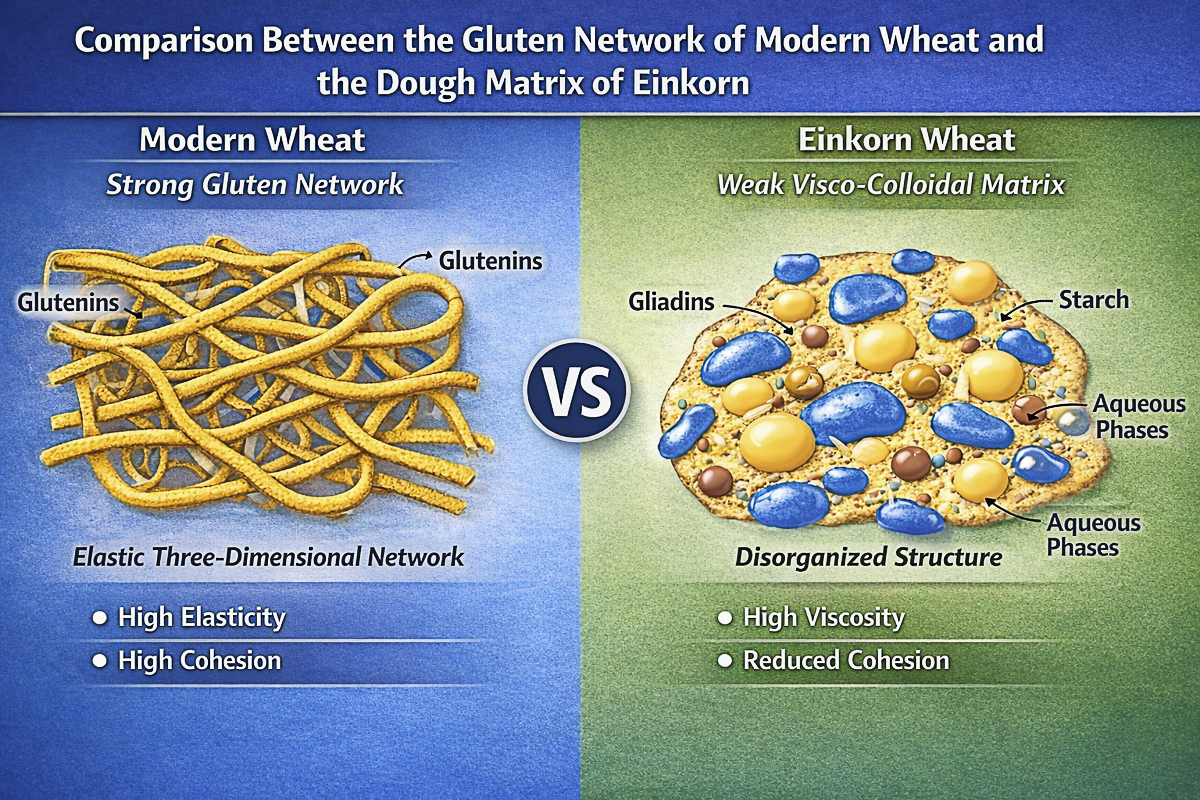
The protein composition of einkorn is characterized by a relative predominance of gliadins (including γ-gliadins) and by a lower quantity and quality of polymeric glutenins. Gliadins mainly contribute to the viscous properties of the dough, while polymeric glutenins are responsible for elastic properties and for the formation of a stable three-dimensional gluten network.
This specific protein composition results in a rheological system in einkorn that behaves predominantly as a pasty-viscous system rather than an elastic one (Figure 1). Consequently, doughs obtained from einkorn flours are generally less elastic, more viscous and have a limited capacity to retain gas during fermentation.
Scientific references
Wieser, H. (2007). Chemistry of gluten proteins. Food Microbiology. DOI: 10.1016/j.fm.2006.07.004
Abdel-Aal, E.-S. M. et al. (1998). Genetic and environmental effects on gluten proteins of einkorn wheat. Journal of Cereal Science. DOI: 10.1006/jcrs.1997.0143
2. Role of Bran in Dough: General Concepts
Bran represents a fundamental component of wholegrain flours and can significantly influence the rheological properties of dough and the quality of the final product. The effect of bran on dough is generally attributed to two main mechanisms: interaction with water and mechanical interference with the dough structure.
2.1 Water absorption effect
Bran particles possess a remarkable capacity to absorb water due to their high content of dietary fiber, particularly arabinoxylans and cellulose. As the specific surface area of bran particles increases, their capacity to bind water also increases.
✅ This phenomenon results in a reduction of water available for other dough components, particularly starch and gluten proteins. Consequently, the distribution of water in the dough can significantly modify the formation and stability of the protein matrix.
2.2 Mechanical effect of bran particles
In addition to the water-related effect, bran can exert a mechanical effect on the dough structure. Bran particles of large size may act as discontinuous elements within the dough matrix, interfering with the continuity of the gluten network.
In modern wheats, characterized by a relatively strong and elastic gluten network, coarse bran particles can physically interrupt the protein network, resulting in a reduced ability of the dough to retain gas and, consequently, a decrease in final bread volume.
References
Noort, M. W. J. et al. (2010). The effect of particle size of wheat bran on bread quality. Journal of Cereal Science. DOI: 10.1016/j.jcs.2010.03.003
Hemdane, S. et al. (2016). Wheat bran in bread making: A critical review. Food Chemistry. DOI: 10.1016/j.foodchem.2015.09.092
3. Effect of Bran Particle Size on Dough Properties
The size of bran particles represents a particularly important technological parameter, as it influences both water absorption capacity and mechanical interaction with the dough structure.
3.1 Fine bran
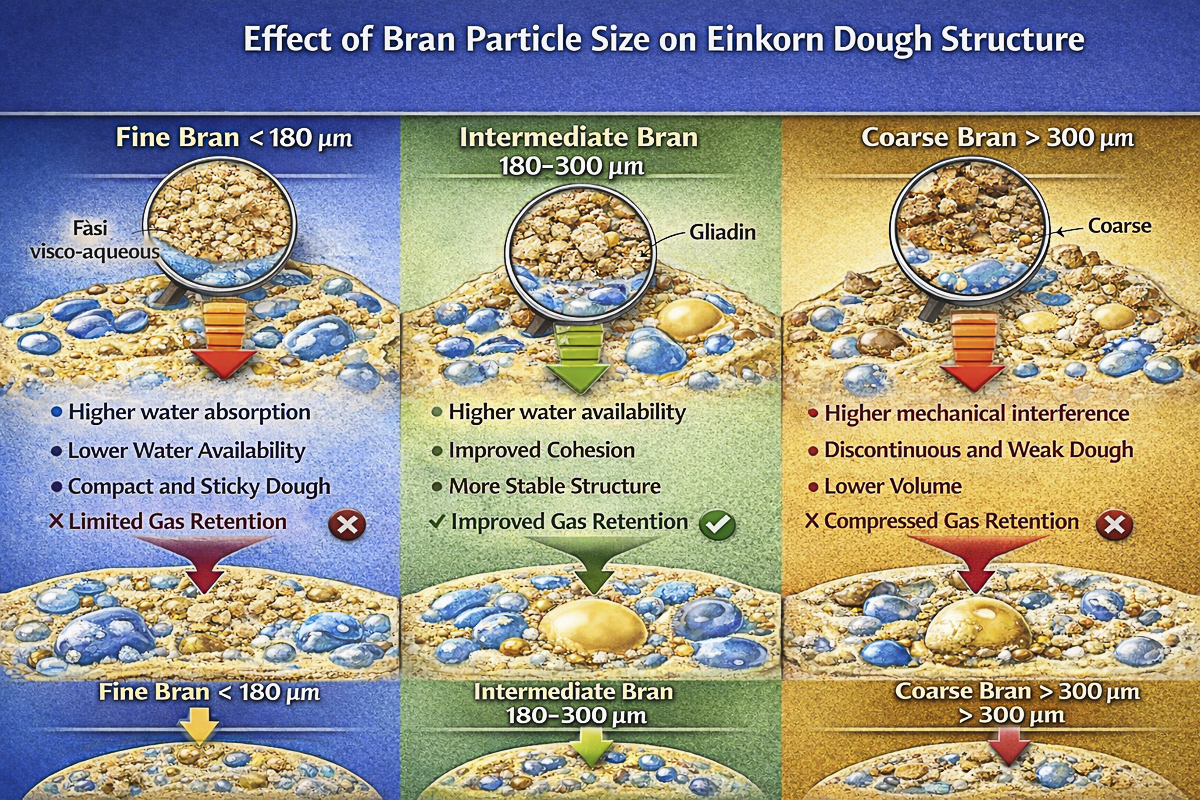
Fine bran presents a high specific surface area. This results in a greater capacity to absorb water compared to larger particles.
In the presence of fine bran, the following are generally observed:
1️⃣ lower water availability for proteins and starch
2️⃣ higher water absorption by bran
3️⃣ more homogeneous distribution of particles in the dough.
From a technological point of view, these effects may lead to the formation of more viscous and compact doughs, with a more limited but generally more uniform development of dough structure.
3.2 Coarse bran
Bran with larger particle size presents a lower specific surface area and therefore tends to absorb less water during the initial phases of mixing.
However, larger particles may exert a stronger mechanical effect on the dough structure. In modern wheats this phenomenon may cause discontinuities in the gluten network, resulting in reduced dough stability and lower final bread volume.
4. Technological Specificity of Einkorn
In the case of einkorn, the effect of bran must be interpreted in light of the specific characteristics of its protein matrix.
As previously described, the gluten network of einkorn is generally weaker than that of modern wheats and does not form an equally developed continuous elastic structure. Dough behavior is dominated more by viscosity and colloidal cohesion phenomena rather than by a well-organized elastic gluten network.
✅ In this technological context, bran does not necessarily act as an element that breaks a strong gluten network, as occurs in modern bread wheat. However, it may still interfere with dough cohesion or contribute to the stabilization of the overall structure of the system.
References
Hidalgo, A. & Brandolini, A. (2014). Nutritional properties of einkorn wheat. Journal of the Science of Food and Agriculture. DOI: 10.1002/jsfa.6382
Brandolini, A. et al. (2008). Technological quality of einkorn wheat. Journal of Cereal Science. DOI: 10.1016/j.jcs.2008.01.001
5. Recent Evidence on the Technological Properties of Einkorn
In recent years several studies have analyzed the technological properties of einkorn and the behavior of its dough during processing.
A study conducted in 2023 analyzed several einkorn lines in order to evaluate flour, dough and bread properties. The results showed that einkorn generally has a higher protein content than bread wheat, but forms weaker gluten. The viscoelastic moduli of the doughs were lower than those of modern wheat and the rheological behavior of the dough was more viscous than elastic.
These results confirm that the structural system of einkorn is less organized and shows characteristics more similar to a colloidal system compared to the more elastic gluten structure of modern wheats.
An integrated study published in 2025 analyzed three ancient hulled wheat species: einkorn (Triticum monococcum), emmer (Triticum dicoccum) and spelt (Triticum spelta). The results confirmed that einkorn has relatively low breadmaking strength but can produce breads with highly appreciated sensory characteristics.
In summary:
✅ Reduced absorption compared with fine bran
greater water availability for:
proteins
starch
? possible improvement in dough workability
✅ Lower mechanical effect compared with coarse bran
less structural discontinuity
better dough cohesion
✅ “Structuring” effect in the viscous system
In einkorn, intermediate bran may:
act as a structural filler
contribute to the stabilization of gas bubbles
improve gas retention during proofing
Possible result:
less sticky dough
relative increase in final bread volume compared with fine bran
Chat GPT: Therefore your hypothesis (intermediate bran particle size in einkorn) is scientifically plausible but still little explored directly, which makes it interesting from a research perspective.
6. Recent Studies on Bran Particle Size
Recent literature has clearly shown that bran particle size represents a decisive technological parameter in the quality of wholegrain flours.
A study published in Food Chemistry in 2022 compared bran with different particle sizes:
1️⃣ coarse bran about 362 micrometers
2️⃣ medium bran about 60 micrometers
3️⃣ superfine bran about 11 micrometers.
The results showed that fine bran significantly increases dough water absorption, while coarse bran causes greater structural discontinuity. Particle size also influences bread structure, crumb texture, starch digestibility and dough stability.
A recent review published in 2025 on wholegrain flour technology highlighted that:
1️⃣ large bran particles tend to produce more compact and less porous breads,
2️⃣ finer particles favor greater extraction of bioactive compounds and directly influence extensibility, volume and bread texture.
A 2023 study analyzed three bran particle-size classes:
1️⃣ coarse ≥ 300 micrometers
2️⃣ medium between 300 and 180 micrometers
3️⃣ fine ≤ 180 micrometers.
The results showed that water absorption increases with the amount of bran, while dough stability decreases with larger particles. In some cases, carbon dioxide production during fermentation may increase with finer particles.
7. Knowledge Gap in the Scientific Literature
Despite the extensive literature on the effects of bran in wheat flours, there is still a significant knowledge gap regarding the interaction between bran particle size and dough properties in einkorn.
Most available studies concern:
modern bread wheat
conventional wholegrain flours
levels of added bran rather than optimized particle size.
Very few studies have simultaneously analyzed:
einkorn
bran particle size
dough microstructure
fermentation stability.
8. Technological Hypothesis: Intermediate Bran Particle Size
In light of the rheological characteristics of einkorn and the available knowledge on the effects of bran in dough systems, it is possible to hypothesize that an intermediate bran particle size could produce favorable technological effects.
An intermediate particle size could generate a combined effect between the properties of fine particles and those of coarse particles.
1️⃣ First, intermediate bran particle size could reduce water absorption compared with very fine bran, making a greater amount of water available for proteins and starch. This could improve dough workability.
2️⃣ Second, intermediate-size particles could reduce the mechanical structural discontinuity effect typical of very coarse particles, helping to maintain greater dough cohesion.
3️⃣ In the visco-colloidal system of einkorn dough, bran particles with intermediate particle size could act as structuring elements of the matrix, functioning as colloidal fillers capable of contributing to the stabilization of gas bubbles during fermentation.
The potential technological result could be the formation of a less sticky dough and a relative increase in final bread volume compared with flours containing very fine bran.
9. Integrated Study on Ancient Hulled Wheats (2025)
Evaluation of einkorn, emmer and spelt genotypes through a field-to-consumer approach: agronomic performance, grain quality, bread characteristics and sensory traits.
Lo Porto, A. L. et al. Journal of Stored Products Research.
DOI 10.1016/j.jspr.2025.102024
The study adopted an integrated approach defined as field-to-consumer to simultaneously analyze agronomic, compositional, technological and sensory aspects of three ancient hulled wheat species:
Triticum monococcum
Triticum dicoccum
Triticum spelta.
Sixteen genotypes were analyzed, cultivated in two different Mediterranean semi-arid soil types, while three durum wheat varieties were used as a technological reference.
The study analyzed:
agronomic performance
grain quality
chemical composition
phenolic compound content
aroma profile of volatile compounds
technological properties of dough
bread characteristics
sensory analysis of the final product.
Main results related to einkorn
The study confirmed several typical characteristics already known for einkorn:
1. Limited breadmaking strength
Einkorn flour showed:
low dough stability
lower strength of the protein network
weaker rheological behavior compared with modern wheat.
This is related to gluten composition, dominated by gliadins and with a lower presence of polymeric glutenins, resulting in a less elastic gluten network.
2. More fragile dough during processing
During baking trials:
einkorn dough showed lower tolerance to processing
greater sensitivity to mixing and fermentation
a more unstable and viscous structure.
This behavior is consistent with the visco-colloidal structure of the einkorn protein system.
3. Good sensory quality of bread
Despite lower breadmaking strength, the breads obtained showed:
rich aromatic profile
good crust and crumb color
positive sensory evaluations.
In particular, aromatic and phenolic compounds present in einkorn contribute to improving flavor and nutritional quality of the final product.
Technological significance of the study
The study highlights a very important aspect for the technology of ancient grains:
ancient wheats should not be evaluated only with the classical parameters of industrial breadmaking
their quality is often more related to sensory and nutritional characteristics than to dough strength.
For this reason, technological optimization (milling processes, fermentation or formulation) becomes essential to exploit their potential.
Reference
Lo Porto, A. L. et al. (2025).
Evaluation of einkorn, emmer and spelt genotypes through a field-to-consumer approach: agronomic performance, grain quality, bread characteristics and sensory traits.
Journal of Stored Products Research.
DOI: 10.1016/j.jspr.2025.102024
10. Genotypes Analyzed in the Study
The study by Lo Porto et al. (2025) analyzed sixteen genotypes belonging to three species of ancient hulled wheats: einkorn (Triticum monococcum), emmer (Triticum dicoccum) and spelt (Triticum spelta). The selection of genotypes was designed to represent different levels of genetic, agronomic and technological variability.
Einkorn (Triticum monococcum)
-
Hammurabi
-
Monlis
-
Norberto
-
ID331
-
ID388
Emmer (Triticum dicoccum)
-
Padre Pio
-
Giovanni Paolo
-
Farvento
-
Molise sel. Colli
-
Zefiro
-
Giovanni Paolo II
Spelt (Triticum spelta)
-
Altgold
-
Oberkulmer Rotkorn
-
Bauländer Spelz
-
Frankenkorn
-
Zollernspelz
Scientific significance of genotype selection
The selection of these sixteen genotypes was designed to represent different biological and technological characteristics of the three species. In the case of einkorn, the main interest concerns the relatively high protein content and the aromatic potential of the bread produced. Emmer is known for high intraspecific variability in agronomic and nutritional parameters. Spelt generally presents greater agronomic stability but shows significant differences in the profile of volatile organic compounds (VOC) responsible for the aromatic characteristics of baked products.
This experimental design allowed the authors to analyze:
the relationships between genotype and technological bread quality
correlations between phenolic compounds, VOC and sensory perception
the potential of hulled wheats for marginal or low-input agricultural systems.
11. Immunological Aspects of Einkorn Gliadins
In addition to technological differences, einkorn also presents peculiar characteristics in the composition of gluten proteins that have attracted the interest of nutritional and immunological research. From a genetic point of view, Triticum monococcum possesses a diploid genome (AA), while modern bread wheat (Triticum aestivum) is hexaploid (AABBDD).
The presence of three distinct genomes in modern wheats results in greater genetic diversity of gluten proteins, particularly α-gliadins, and therefore a higher number of immunogenic epitopes recognized by the immune system of celiac patients.
One of the most studied fragments is the 33-mer peptide, derived from the digestion of α-gliadin. This peptide is particularly resistant to enzymatic degradation and contains six immunodominant epitopes recognized by T cells of celiac patients.
In einkorn the canonical 33-mer peptide is generally absent, because the α-gliadin sequences generating it are mainly associated with the D genome, which is absent in this species. However, some einkorn lines may contain related T-cell epitopes in gliadins encoded by the A genome.
Gluten genomics studies also indicate that einkorn possesses a significantly lower number of immunogenic epitopes, estimated at approximately 5–10 times fewer than in hexaploid wheats. This reflects the lower genetic complexity of gliadins present in the diploid genome.
It is important to emphasize that this reduction in the number of epitopes does not imply safety for celiac patients. Several immunological studies have shown that peptides derived from einkorn gliadins can still induce an immune response in T cells of celiac patients.
For this reason, despite the growing scientific interest in einkorn as a model for reducing gluten immunogenicity, no einkorn variety is currently considered suitable for a gluten-free diet.
In-depth: immunogenicity of genotype ID331 (Norberto)
Some studies have specifically analyzed the einkorn genotype ID331 (commercially known as Norberto) to evaluate its potential role in reducing exposure to immunogenic gluten epitopes.
A comparative study published in Frontiers in Nutrition compared the immunological properties of gliadins from Triticum monococcum (Hammurabi and Norberto-ID331) with those of modern wheats. The results showed that einkorn gliadins present higher gastrointestinal digestibility and a significant reduction in the ability to activate celiac T cells after enzymatic digestion compared with hexaploid wheat. In particular, after simulated gastro-duodenal digestion, IFN-γ production by T cells was significantly reduced in the case of einkorn compared with reference durum wheat.
Another in vivo study evaluated the immune response in celiac patients exposed to Triticum monococcum flour cultivar Norberto-ID331. After three days of controlled consumption, no significant mobilization of gluten-specific T cells was observed in peripheral blood, whereas hexaploid wheat induced a marked immune response. The authors concluded that diploid einkorn may induce a significantly lower immune response compared with modern wheat, although it is still not suitable for the diet of celiac patients.
Studies on intestinal cellular models have also shown that peptides derived from gliadins of genotype ID331 have a lower capacity to alter epithelial permeability and to induce innate intestinal responses compared with peptides derived from common wheat (Triticum aestivum). This suggests qualitative differences in the composition of einkorn prolamins that may contribute to lower relative toxicity.
Overall, this evidence indicates that some einkorn lines, including ID331 (Norberto), may present fewer immunostimulatory epitopes and greater susceptibility to gastrointestinal digestion compared with modern wheats.
These characteristics do not make einkorn safe for celiac patients. However, some lines — such as Hammurabi and Norberto (ID331) — are of considerable scientific interest because they may contribute to reducing overall exposure to gluten epitopes compared with hexaploid wheats.
This aspect makes einkorn the subject of growing interest in nutritional research, particularly in the context of individuals at risk of celiac disease or with non-celiac gluten sensitivity (NCGS).
Possible use
The interaction between gluten and the human organism is closely related to the physiological condition of the individual and their overall biological context. Several factors — including diet, stress, lifestyle and environmental conditions — may influence the individual response to gluten.
For this reason, the potential consumption of einkorn-based products should be evaluated on a case-by-case basis and always under medical supervision, taking individual clinical conditions into account.
Scientific references
Di Stasio L. et al. (2020)
Comparative Analysis of in vitro Digestibility and Immunogenicity of Gliadin Proteins from Durum and Einkorn Wheat.
Frontiers in Nutrition. DOI: 10.3389/fnut.2020.00056
Picascia S. et al. (2020)
In Celiac Disease Patients the In Vivo Challenge with the Diploid Triticum monococcum Elicits a Reduced Immune Response Compared to Hexaploid Wheat.
Molecular Nutrition & Food Research.
Iacomino G. et al. (2016)
Protective effects of Triticum monococcum ID331 gliadin-derived peptides on intestinal epithelial cells.
Food Chemistry.
Molberg Ø. et al. (2005)
Identification of potentially immunogenic epitopes in α-gliadins from Triticum monococcum.
DOI: 10.1073/pnas.0501814102
Gianfrani C. et al. (2012)
Immunogenicity of monococcum wheat in celiac disease.
DOI: 10.1002/mnfr.201100749
Pizzuti D. et al. (2006)
Gliadin peptides from Triticum monococcum are toxic for celiac patients.
DOI: 10.1093/jn/136.3.696
Spaenij-Dekking L. et al. (2005)
Immunogenicity of wheat species in celiac disease.
DOI: 10.1136/gut.2004.051995
12. Scientific Conclusion
Available scientific evidence indicates that einkorn possesses a dough rheological structure characterized by a relatively weak visco-colloidal matrix. Bran influences dough properties mainly through mechanisms of water absorption and structural interference. Bran particle size therefore represents a crucial technological parameter for the quality of wholegrain flours. However, the specific effect of an intermediate bran particle size in einkorn is still poorly studied. The hypothesis that an intermediate particle size could improve the balance between water absorption, dough cohesion and fermentation stability appears consistent with current scientific knowledge, but requires further experimental verification.

Back