Protein structure, dough behaviour and immune-system response
Central message. In einkorn wheat, knowing the total protein content or the number of electrophoretic bands is not enough. Properties depend on which subunits are present, their abundance, the positions of cysteines, the ability of glutenins to build polymers, and the peptides that remain after digestion. Technological performance and immunogenicity are distinct dimensions: a technologically superior cultivar is not necessarily biologically more favourable.
PART I – STICKINESS, VISCOSITY AND THE MACROPOLYMER IN EINKORN WHEAT
- Three terms that must not be confused
1.1 Stickiness
Stickiness is the tendency of dough to adhere to hands, tools or surfaces. It is an interfacial property: it arises at the contact between dough and an external material, but it also depends on internal structure. Highly deformable dough with poor elastic recovery and mobile water increases its true contact area and may leave residues when detached. Hydration, temperature, resting time, mixing, damaged starch, pentosans and proteolytic activity can alter stickiness even when protein sequences do not change.
Limit of the evidence. No published comparisons appear to have directly measured the stickiness of Monlis, ID331/Norberto and Hammurabi with the same instrumental test. The farinograph, alveograph, Gluten Index, SDS sedimentation and G′/G″ moduli describe related properties, but not the work required to detach dough from a surface.
1.2 Viscosity and viscoelasticity
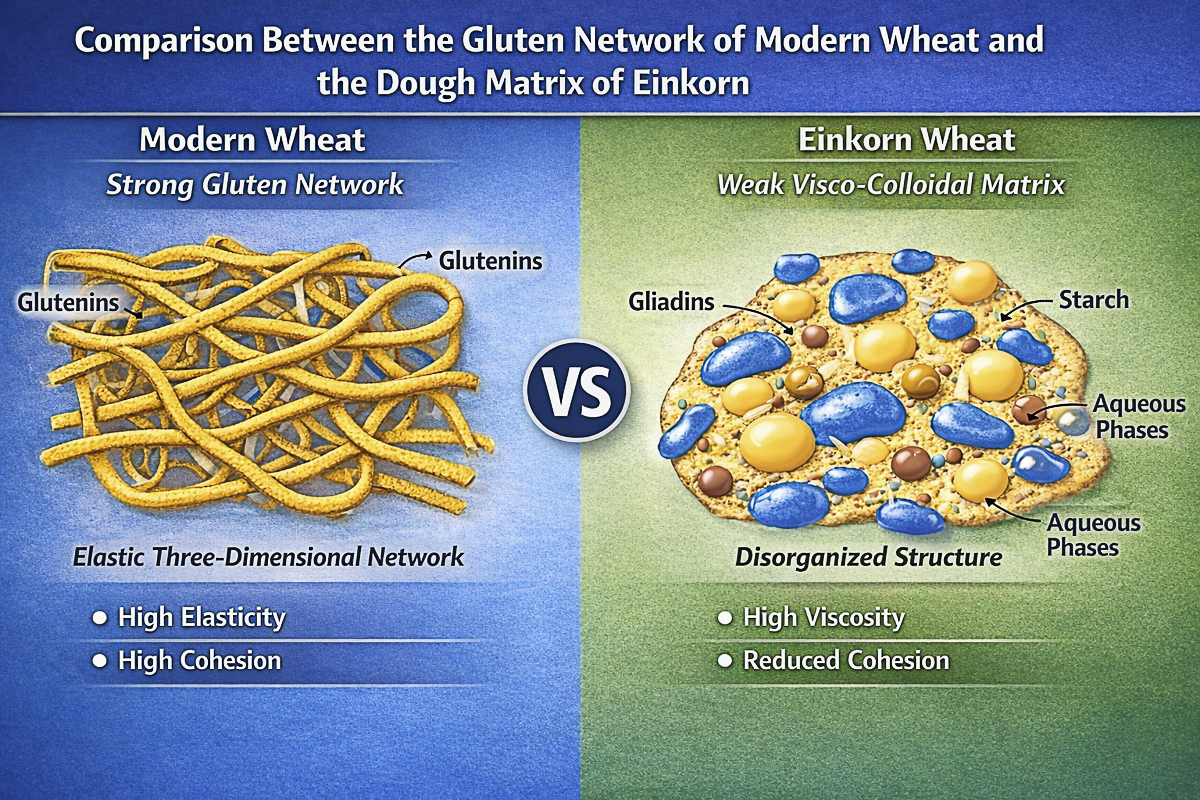
Viscosity is resistance to flow. Dough, however, is not a simple liquid: it is viscoelastic. The G′ modulus represents the elastic component that stores energy and tends to recover its shape; G″ represents the dissipative, viscous component. Gliadins promote mobility and extensibility; glutenins, through disulfide-linked polymers, increase cohesion, resistance to deformation and especially G′. Both therefore contribute to overall viscous behaviour, but in different ways.
The “final viscosity” measured with the RVA mainly describes starch gelatinisation and retrogradation during heating and cooling. It is equivalent neither to the viscosity of the gluten network at room temperature nor to the stickiness of raw dough.
1.3 Glutenin macropolymer: from subunit to network
The glutenin macropolymer (GMP), often also studied as the SDS-unextractable polymeric protein fraction (UPP), consists of extremely large glutenin aggregates. HMW-GS create extension and branching points in the polymer; the more abundant LMW-GS make numerous connections and enlarge the network. Intermolecular disulfide bonds provide the covalent framework, supported by hydrogen bonds, hydrophobic interactions and physical entanglements.
During hydration and mixing, the network is not simply “created”: pre-existing polymers hydrate, align, break and reform through thiol-disulfide interchange. An abundant, well-connected GMP is generally associated with greater elasticity, stability and gas retention. If the polymer is small, poorly branched or depolymerised, softening, flow and collapse predominate.
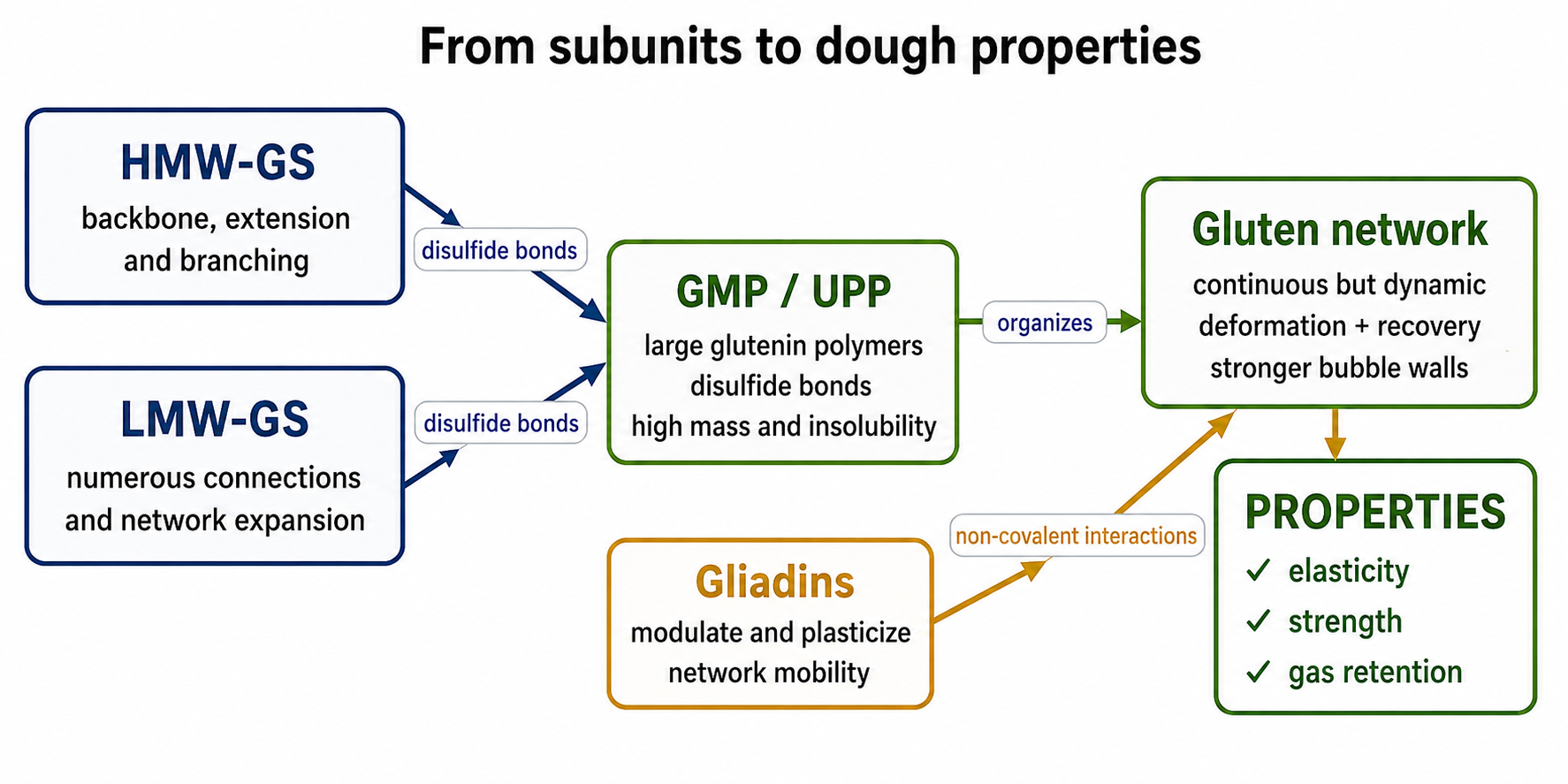
Figure 1. From subunits to the network: HMW-GS and LMW-GS build the macropolymer; gliadins modulate its mobility and extensibility.
1.4 Do glutenins contribute to stickiness and viscosity?
They contribute to viscosity and viscoelasticity: polymer size, the HMW/LMW ratio and the UPP/GMP fraction affect resistance to flow, G′, stability and recovery. Their contribution to stickiness is mainly indirect. A functional glutenin network keeps dough cohesive, limits deformation at contact and promotes detachment; a weak network allows more spreading and surface residue. More glutenin, however, does not automatically guarantee less stickiness: polymer architecture, water, mixing and the ratio to gliadins all matter.
✓ Highly polymerised glutenins: greater cohesion and elastic recovery; often less tendency to leave residues.
✓ Depolymerised or poorly connected glutenins: lower stability and greater yielding; apparent stickiness may increase.
✓ Adhesion and cohesion are not synonyms: a dough may be highly cohesive yet still adhere to a particular surface.
- What the gliadin and glutenin subunits do
2.1 α/β-, γ- and ω-gliadins
Gliadins are predominantly monomeric and act as plasticisers: they interpose between glutenin polymers, reduce effective interactions between chains and facilitate sliding. They therefore increase extensibility and the viscous component. “Plasticising” does not simply mean weakening: an adequate proportion lets the network deform without breaking; an excess relative to glutenins instead makes dough yielding and less stable.
✓ α/β-gliadins: glutamine- and proline-rich monomers; they contribute to viscosity and extensibility and include many known coeliac epitopes.
✓ γ-gliadins: they normally possess cysteines involved in intramolecular bonds; variants with free cysteines can modify or terminate glutenin chains. Their possible role in ID331 stickiness remains a hypothesis to be tested.
✓ ω-gliadins: generally lack cysteines and do not enter the GMP covalently; they participate chiefly through hydration and non-covalent interactions. Their number of bands alone does not measure the quantity present.
2.2 HMW-GS and LMW-GS
HMW-GS are quantitatively minor but decisive for architecture: x- and y-type subunits differ in mass, sequence and number of cysteines, and therefore in their ability to create extensions and branches. LMW-GS are more numerous and account for a large proportion of polymer mass; types B, C and D differ in mobility and structure, but electrophoretic classification does not always correspond to a single function. Einkorn, which has only the A genome, has a simpler repertoire than hexaploid bread wheat, but allelic variability remains important.
- Monlis, ID331/Norberto and Hammurabi
The following values describe specific samples, crop years and protocols. They are not immutable constants of the cultivars.
| Parameter |
Hammurabi |
ID331 |
Monlis |
|---|---|---|---|
| Farinograph development (min) |
2.0 |
3.7 |
8.0 |
| Stability (min) |
0.6 |
3.0 |
9.6 |
| Softening (FU) |
181 |
68 |
7 |
| Water absorption (%) |
59.2 |
60.3 |
56.5 |
| Alveograph W (10⁻⁴ J) |
11 |
52 |
35 |
| P/L |
0.61 |
6.7 |
6.7 |
3.1 Monlis
Monlis is technologically atypical among einkorns: it has a relatively favourable glutenin fraction, good sedimentation and higher stability within the group studied. The absence of ω-gliadins may reduce a monomeric component that cannot be incorporated into the GMP, but it does not by itself demonstrate the existence of a large polymer. The advantage should be attributed to the overall subunit profile and gliadin/glutenin ratio. This technological profile does not imply lower biological activity: in comparative studies Monlis produced more problematic cellular effects than ID331.
3.2 Original ID331 and commercial Norberto
ID331, the line from which Norberto was registered, possesses a single ω-gliadin. In the CREA data reported in Gazzelloni’s thesis, it reaches W = 52, stability = 3.0 min and softening = 68 FU: better than Hammurabi, but still weak in absolute terms and very unbalanced in P/L.
A later commercial Norberto sample showed W = 84 ± 4, P/L = 1.6 ± 0.4, Gluten Index = 52 ± 2 and SDS = 58.5 ± 0.7 ml. The difference documents variability in the material and conditions; without a controlled experiment, it does not permit the increase to be attributed causally to fertilisation or lot selection.
The marked stickiness observed while processing ID331/Norberto can coexist with acceptable sedimentation and gas retention. The hypothesis that numerous γ-gliadins modulate the viscous phase is plausible, but it requires proteomic quantification and a detachment test. It is not yet a demonstrated relationship.
3.3 Hammurabi
Hammurabi has 12–13 bands attributed to ω-gliadins and, in the samples studied, a very high total protein content but an extremely weak network: very short development and stability, pronounced softening and very low W. Its exceptional stickiness observed in practice is compatible with a poorly connected and readily deformable network. The numerous ω-gliadins may dilute the polymeric fraction, but without GMP/UPP, free water and stickiness measured in the same experiment, no causal weight can be assigned to them.
- Why abundant protein does not mean strong dough
Protein content measures how much protein is present, not how much of it is organised into a functional network. Hammurabi may exceed 20% protein and still have extremely low W and stability. Strength depends on the glutenin fraction, the expressed subunits, available cysteines, polymer size, the HMW/LMW ratio, the gliadin/glutenin proportion and agronomic conditions. Nitrogen can increase protein and strength, but the effect varies with genotype, sulfur, dose, timing, environment and response saturation.
| Cultivar | Observed protein | Strength/stability | Structural interpretation |
|---|---|---|---|
| Monlis | high, not decisive | greater stability within the group | relatively more functional network |
| ID331 | high | intermediate and variable strength | adequate but not “strong” arrangement |
| Hammurabi | even >20% | very low W and stability | abundant protein, few functional polymers |
- Other einkorns and limits of comparison
Documented Italian cultivars include Monlis, Norberto, Hammurabi, Antenato and Monili. Agronomic descriptions are available for Antenato and Monili, but not a complete comparative characterisation of subunits, GMP, stickiness and performance in bread, pizza and pasta.
A particularly weak Balkan einkorn may also be informative, provided the material’s identity, lot, environment, milling and protocol are known. Einkorn variability is broad and prevents the profile of a single cultivar from being automatically extended to the entire species.
PART II – RELATIONSHIP BETWEEN SUBUNITS AND THE CAPACITY TO ACTIVATE ADVERSE RESPONSES
- Subunits and the immune system
Gluten comprises gliadins and glutenins; both can generate peptides recognised by the immune system. In coeliac disease, proline- and glutamine-rich peptides partly resist digestion, may be deamidated by transglutaminase 2 and presented by HLA-DQ2 or HLA-DQ8 to T lymphocytes.
Epitopes have been described in α-, γ- and ω-gliadins and also in HMW- and LMW-glutenins. Gliadins remain the most widely studied and often immunodominant source, but “glutenin” does not mean immunologically inert.
1.1 Do glutenins participate in the response?
Potentially, yes. After reduction or digestion, glutenin subunits release peptides that may share motifs with gliadin epitopes or possess their own epitopes. LMW-GS are particularly relevant because of their abundance and sequence homologies; epitopes have also been reported in HMW-GS.
The actual capacity to activate a response nevertheless depends on the sequence of the specific subunit, digestion, deamidation, the individual’s HLA and the dose. It cannot be inferred from electrophoretic class or molecular weight alone.
Clinical warning. All einkorn wheat contains gluten and is unsuitable for the diet of people with coeliac disease. A lower average response than that to bread wheat is not equivalent to individual safety and does not authorise consumption.
-
Specific evidence on ID331/Norberto
A. (1) – [Omitted]. On the other hand, given that the incidence and severity of coeliac disease depend on the quantity and harmfulness of prolamins, and that some einkorn genotypes combine high breadmaking quality with an absence of cytotoxicity and reduced immunogenicity, it is expected that using einkorn flours in the diet of the general population – within which there is a high percentage of individuals genetically predisposed to coeliac disease but not yet coeliac – could help contain the spread of this form of food intolerance.
This suggests that einkorn wheat, recently brought back into cultivation in Italy by researchers from the Council for Agricultural Research and Experimentation (CRA) in Rome and Sant’Angelo Lodigiano, may play an important role in preventing coeliac disease, both directly in the form of bread and pasta and indirectly as a model species for studying the role of innate immunity in the onset of coeliac disease.
From: Le nuove frontiere delle tecnologie alimentari e la celiachia, Norberto Pogna, Laura Gazza (2013). Volume 212, 1 December 2016, pages 537–542.
(2) – [Omitted]. Abstract. A growing interest in developing new strategies for preventing coeliac disease has motivated efforts to identify cereals with null or reduced toxicity. In the current study, we investigate the biological effects of ID331 Triticum monococcum gliadin-derived peptides in human Caco-2 intestinal epithelial cells. Triticum aestivum gliadin-derived peptides were employed as a positive control.
The effects on epithelial permeability, zonulin release, viability, and cytoskeleton reorganisation were investigated. Our findings confirmed that ID331 gliadin did not enhance permeability and did not induce zonulin release, cytotoxicity or cytoskeleton reorganisation of Caco-2 cell monolayers.
We also demonstrated that ID331 ω-gliadin and its derived peptide ω(105–123) exerted a protective action, mitigating the injury of Triticum aestivum gliadin on cell viability and cytoskeleton reorganisation. These results may represent a new opportunity for the future development of innovative strategies to reduce gluten toxicity in the diet of patients with gluten intolerance.
Protective effects of ID331 Triticum monococcum gliadin on in vitro models of the intestinal epithelium. Giuseppe Iacomino et al., 2016.
(3) – [Omitted]. The 2015 study by Gianfrani et al. found that:
“In conclusion, we demonstrated that the gliadin proteins of einkorn wheat (TM) differ sufficiently from those of common bread wheat (TA) to produce lower immune toxicity after an in vitro simulation of human digestion.
The intensity of the T-cell response to gluten peptides was observed to depend on the number of HLA-DQ2 gene copies in coeliac patients [31]. This finding suggests a quantitative model, based on the relationship between HLA status and gluten epitopes, for reaching a pathological T-cell response.
We therefore hypothesise that a habitual diet based on ancient einkorn wheat, characterised by a lower quantity of immunotoxic gluten peptides, could delay the onset of coeliac disease, especially in people at risk, such as first-degree relatives of coeliac patients who carry coeliac-associated HLA alleles.”
Conclusion
“Einkorn wheat is frequently used by people with non-coeliac gluten sensitivity (NCGS), although definitive clinical evidence validated on a large scale is lacking and subject to specific individual intolerances established clinically.
From a research perspective, the shortage of structured clinical studies is linked to economic sustainability: private funding tends to focus on proprietary industrial assets, while public institutions, constrained by limited resources, prioritise health areas with greater epidemiological impact.
Nevertheless, the current widespread consumption of this variety provides an empirical indicator in the community: any significant incidence of adverse reactions would be promptly detected and highlighted by active health-surveillance channels through the daily practice of general practitioners, gastroenterologists and nutritionists.”
PART III – SUBUNITS AND DOUGHS FOR BREAD, PIZZA AND PASTA
-
Role of subunits in technological use
Bread, pizza and pasta require different balances. There is no composition that is absolutely “better”: what matters is the combination of resistance, extensibility, stability over time and the ability to withstand processing.
1.1 Gliadin subunits: differences between bread and pasta
In bread, α/β- and γ-gliadins promote plasticity, extensibility and network relaxation, allowing dough to expand under gas pressure. If they predominate over polymeric glutenins, however, the mass may become stickier, yield during proofing and retain less gas.
ω-gliadins, which contain few or no cysteines, participate little or not at all in the macropolymer; a high relative abundance may therefore dilute the fraction capable of building the network. No gliadin family taken in isolation, however, defines breadmaking aptitude.
In pasta, gliadins contribute the deformability needed during mixing and extrusion, whereas cooking performance depends mainly on the glutenin matrix, particularly LMW-GS.
A well-known example in durum wheat is γ-gliadin 45, associated with strong gluten and good cooking quality; γ-gliadin 42 is more often associated with poorer quality. γ-45, however, is primarily an electrophoretic marker: it is closely linked to the LMW-2 glutenin group, considered chiefly responsible for the favourable effect, whereas γ-42 is linked to LMW-1. Because these markers belong to the B genome of durum wheat, they must not be transferred automatically to einkorn, which possesses only the A genome [15].
| Product | Desirable structure | Role of the subunits | Risk in einkorn |
|---|---|---|---|
| Bread | continuous, extensible, gas-retaining network | HMW-GS for backbone and branching; LMW-GS for connections; enough gliadins for expansion | overmixing, collapse and low volume |
| Pizza | balance of extensibility, holding capacity and relaxation | glutenins for holding during fermentation; gliadins for stretching without excessive spring-back | stickiness, tearing or excessively tenacious dough |
| Pasta | cohesion in low-hydration dough and resistance during cooking | glutenin polymers for the protein matrix; gliadins modulate plasticity and extrusion | solids loss, poor holding, fragile structure |
1.2 Bread
Bread needs polymers large enough to retain carbon dioxide, but also enough gliadins to permit expansion. Monlis and ID331/Norberto can produce acceptable or good results within the einkorn context, especially with short mixing and proofing.
Hammurabi does not necessarily lack protein; it lacks a polymeric network capable of supporting expansion.
1.3 Pizza
Pizza requires extensibility without uncontrolled stickiness and stability during fermentation. Einkorn with many gliadins and few large polymers may stretch easily but lose shape or adhere; a high P/L may instead indicate tenacity and poor extension.
Einkorn requires dedicated protocols: cautious hydration, brief mixing, controlled rests and fermentation compatible with the stability of the lot.
1.4 Pasta
In pasta, the network must immobilise starch during extrusion and drying and limit losses during cooking. High protein content is not enough: gluten quality, polymerisation and starch damage matter.
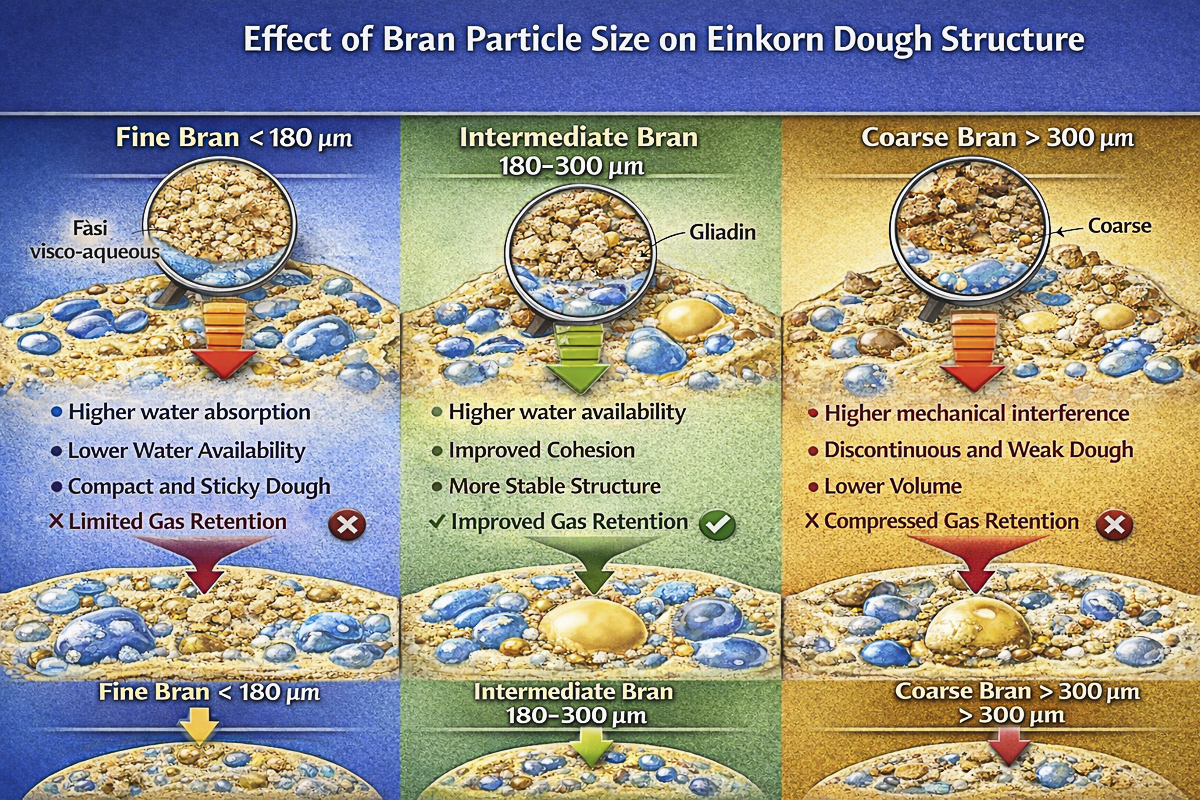
In published data, Norberto shows normal gluten strength within the group studied, while Hammurabi is classified as extremely weak. Behaviour may also change with particle size, drying temperature and the presence of bran.
- A practical interpretation of the cultivars
| Cultivar | Bread | Pizza | Pasta | Interpretive caution |
|---|---|---|---|---|
| Monlis | best structure in the group; good stability | potentially manageable; hydration must be calibrated | possibly good cohesion | atypical protein and immunological profile |
| ID331/Norberto | good potential with a short process | possibly good extensibility, but observed stickiness | Norberto: normal strength in one study | original ID331 and Norberto lots are not interchangeable |
| Hammurabi | network insufficient for high volume | very yielding and potentially sticky | weak holding capacity | stickiness not measured instrumentally |
| Antenato/Monili | insufficient data | insufficient data | insufficient data | full characterisation required |
PART IV – THE RESEARCH THAT IS MISSING
To genuinely connect subunits, stickiness, technological performance and immune response, a study is needed on the same harvest and with the same milling, including Monlis, original ID331 if available, several traceable lots of Norberto, Hammurabi, Antenato, Monili and identified Balkan einkorns.
✓ Quantitative RP-HPLC and LC-MS/MS of α/β-, γ- and ω-gliadins, HMW-GS and LMW-GS, not merely a band count.
✓ Two-dimensional SDS-PAGE/A-PAGE or top-down proteomics to associate every band with a sequence or proteoform.
✓ SE-HPLC with and without reducing agent, UPP and GMP to measure polymer size and proportion.
✓ Instrumental stickiness using a Chen-Hoseney probe, texture analyser or peel test at standard and farinographic hydration.
✓ G′, G″, tan δ, creep-recovery, farinograph, alveograph and stress relaxation.
✓ Free/bound water, damaged starch, arabinoxylans/pentosans, and α-amylase and protease activity.
✓ Separate bread, pizza and pasta trials with adapted processes, together with a common comparison protocol.
✓ Standardised gastrointestinal digestion, epitope peptidomics, T-cell tests and epithelial models using the same flours.
✓ A factorial agronomic design for nitrogen and sulfur across multiple environments and years, to distinguish genotype, fertilisation and their interaction.
A multivariate model could establish whether stickiness is better explained by individual γ or ω proteoforms, the gliadin/glutenin ratio, UPP/GMP, water or non-protein factors. A second model could link sequences released by digestion to the immune response. Without parallel measurements, attributing everything to one protein family remains an oversimplification.
TECHNICAL NOTE – WHAT ELECTROPHORETIC BANDS MEAN
In an electrophoretic gel, proteins migrate and form bands. In SDS-PAGE, separation depends mainly on apparent mass after denaturation; in A-PAGE, it depends more strongly on mobility and charge, and this method has historically been used for gliadins.
A band denotes a migration zone, not necessarily a single protein. Different proteins can co-migrate to the same position, while the same sequence can appear in several forms because of modifications, processing or aggregation.
Band intensity provides, at most, a semiquantitative estimate and depends on extraction, staining, saturation and loaded quantity. Stating that Hammurabi has 12–13 ω bands and ID331 a single band describes an electrophoretic profile; it does not demonstrate that the total quantity of ω-gliadins is 12–13 times greater. Moreover, bands do not directly reveal cysteine positions, GMP membership, epitope sequences or digestibility.
✓ Electrophoresis: excellent for comparing profiles and recognising polymorphisms.
✓ HPLC: better for quantifying families and relative proportions.
✓ Mass spectrometry: necessary for identifying sequences, proteoforms and peptides.
✓ SE-HPLC/GMP-UPP: necessary for describing polymer size and insolubility.
✓ Immunology: requires digested peptides, HLA and cellular tests; it cannot be inferred from the position of a band.
CONCLUSIONS
✓ Glutenins contribute to viscosity and viscoelasticity; they affect stickiness chiefly through cohesion and recovery, but do not determine it alone.
✓ Gliadins plasticise the network; α/β, γ and ω are not interchangeable, and the number of bands is not equivalent to their quantity or function.
✓ HMW- and LMW-glutenins can also generate epitopes; however, the einkorn-specific evidence mainly concerns gliadins and gluten as a whole.
✓ ID331/Norberto shows evidence of lower activity than bread wheat and Monlis in some models, but it contains gluten and is not safe for people with coeliac disease.
ESSENTIAL BIBLIOGRAPHY
[1] Wieser H. Chemistry of gluten proteins. Food Microbiology. 2007;24:115–119. doi:10.1016/j.fm.2006.07.004.
[2] Geisslitz S, Longin CFH, Scherf KA, Koehler P. Comparative study on gluten protein composition of ancient and modern wheat species. Foods. 2019;8:409. doi:10.3390/foods8090409.
[3] Saponaro C, Pogna NE, Castagna R, et al. Allelic variation at Gli-A1m, Gli-A2m and Glu-A1m loci and breadmaking quality in diploid wheat Triticum monococcum. Genetics Research. 1995;66:127–137. doi:10.1017/S0016672300034479.
[4] Hidalgo A, Brandolini A, Gazza L. Breadmaking performance of elite einkorn lines: evaluation of flour, dough and bread characteristics. Foods. 2023;12:1610. doi:10.3390/foods12081610.
[5] Gazza L, et al. Cooking quality and chemical and technological characteristics of wholegrain einkorn pasta obtained from micronized flour. Foods. 2022;11:2905. doi:10.3390/foods11182905.
[6] Di Stasio L, et al. Protective effects of ID331 Triticum monococcum gliadin on in vitro models of the intestinal epithelium. Food Chemistry. 2017;212:537–542. doi:10.1016/j.foodchem.2016.06.014.
[7] Di Stasio L, et al. Comparison of the in vitro toxicity of ancient Triticum monococcum varieties ID331 and Monlis. Food Research International. 2018;105:450–456. doi:10.1016/j.foodres.2017.11.051.
[8] Gianfrani C, et al. Extensive in vitro gastrointestinal digestion markedly reduces the immune-toxicity of Triticum monococcum wheat. Molecular Nutrition & Food Research. 2015;59:1844–1854. doi:10.1002/mnfr.201500126.
[9] Picascia S, et al. In celiac disease patients the in vivo challenge with diploid Triticum monococcum elicits a reduced immune response compared to hexaploid wheat. Molecular Nutrition & Food Research. 2020;64:e1901032. doi:10.1002/mnfr.201901032.
[10] Sollid LM, et al. Nomenclature and listing of celiac disease relevant gluten T-cell epitopes restricted by HLA-DQ molecules. Immunogenetics. 2012;64:455–460. doi:10.1007/s00251-012-0599-z.
[11] Juhász A, et al. Characterization and relative quantitation of wheat, rye, and barley gluten protein types by LC-MS/MS. Frontiers in Plant Science. 2019;10:1530. doi:10.3389/fpls.2019.01530.
[12] Gazzelloni G. Intolleranza al glutine e qualità nutrizionale del grano monococco. Doctoral thesis, Università Campus Bio-Medico di Roma, 2014.
[13] Moi L. Valutazione agronomica e tecnologica di Monlis, ID331 e Hammurabi coltivati in Sardegna. Experimental thesis, University of Sassari, 2013–2014.
[14] Cao Y, et al. Relationship between dough stickiness and wheat gliadin composition based on RP-HPLC. Journal of Henan Agricultural Sciences. 2024;53(6):11–17. doi:10.15933/j.cnki.1004-3268.2024.06.002.
[15] Payne PI, Jackson EA, Holt LM. The association between γ-gliadin 45 and gluten strength in durum wheat varieties: a direct causal effect or the result of genetic linkage? Journal of Cereal Science. 1984;2:73–81. doi:10.1016/S0733-5210(84)80020-X.