
Header Image - Gluten Light
Gallery

Magazine

Sindrome dell’intestino irritabile: c’è un ruolo per il glutine?

by luciano

Uno studio molto importante che evidenzia la sovrapposizione dei sintomi della sindrome dell’intestino irritabile con quelli generati dalla sensibilità al glutine non celiaca dalle ATI e da Fodmaps.

“A tight link exists between dietary factors and irritable bowel syndrome (IBS), one of the most common functional syndromes, characterized by abdominal pain/discomfort, bloating and alternating bowel habits. Amongst the variety of foods potentially evoking “food sensitivity”, gluten and other wheat proteins including amylase trypsin inhibitors represent the culprits that recently have drawn the attention of the scientific community. Therefore, a newly emerging condition termed non-celiac gluten sensitivity (NCGS) or nonceliac wheat sensitivity (NCWS) is now well established in the clinical practice. Notably, patients with NCGS/NCWS have symptoms that mimic those present in IBS. The mechanisms by which gluten or other wheat proteins trigger symptoms are poorly understood and the lack of specific biomarkers hampers diagnosis of this condition. The present review aimed at providing an update to physicians and scientists regarding the following main topics: the experimental and clinical evidence on the role of gluten/wheat in IBS; how to diagnose patients with functional symptoms attributable to gluten/wheat sensitivity; the importance of double-blind placebo controlled cross-over trials as confirmatory assays of gluten/wheat sensitivity; and finally, dietary measures for gluten/wheat sensitive patients. The analysis of current evidence proposes that gluten/wheat sensitivity can indeed represent a subset of the broad spectrum of patients with a clinical presentation of IBS. (J Neurogastroenterol Motil 2016;22:547-557). Umberto Volta, Maria Ines Pinto-Sanchez et al.

Extrac from the study:
…..omissis. Experimental Evidence for a Role of Wheat Components in Irritable Bowel Syndrome. Different mechanisms have been proposed to explain how gluten may trigger gastrointestinal symptoms in the absence of celiac disease (Figure).
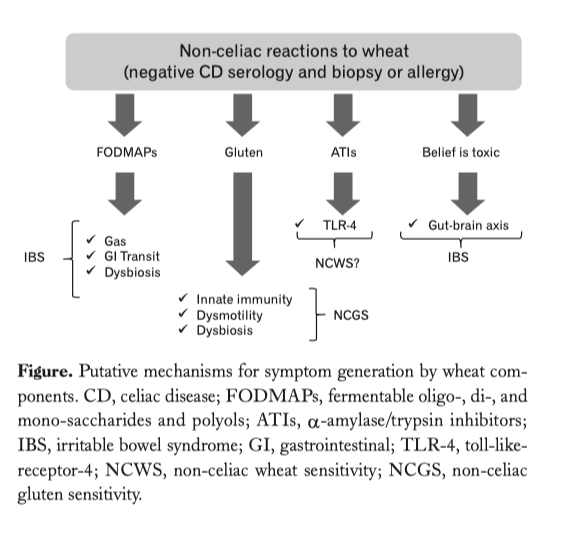
In vitro studies have demonstrated that digests of gliadin increase the expression of co-stimulatory molecules and the production of proinflammatory cytokines in monocytes and dendritic cells (40,57,58). Certain “toxic” (that only stimulates the innate immune response) gliadin-derived peptides such as the 31-43mer, may evoke epithelial cell dysfunction, increased IL-15 production and enterocyte apoptosis (59). Recent studies have demonstrated increased expression of TLR-2 in the intestinal mucosa of non-celiac compared to celiac patients, suggesting a role of the innate immune system in the pathogenesis of non-celiac reactions to gluten or other wheat components (49). Other studies have shown that monocytes from HLA-DQ2+ non-celiac individuals spontaneously release 2-3 fold more IL-8 than monocytes from HLA-DQ2 negative patients. This suggests that patients without celiac disease (no enteropathy and negative specific serology), but with positive HLA-DQ2 status, may represent a subpopulation reacting mildly to gluten (60). In terms of gut dysfunction, gluten sensitization in mice has been shown to induce acetylcholine release, one of the main excitatory neurotransmitters in the gut, from the myenteric plexus (57).
This correlates with increased smooth muscle contractility and a hypersecretory status with increased ion transport and water movements (57). These functional effects induced by gluten were not accompanied by mucosal atrophy, and were not observed after sensitization with non-gluten proteins. Interestingly gluten-induced gut dysfunction was particularly notable in mice transgenic for the human celiac gene HLA-DQ8 (57).
ATIs, a group of wheat proteins that confer resistance of the grain to pests, are strong inducers of innate immune responses via TLR4 and via the myeloid differentiation factor 88-dependent and -independent pathway (40). This activation occurs both in vitro and in vivo after oral ingestion of purified ATIs or gluten, while gluten-free cereals display no or minimal activities (61). The role of ATIs in IBS is not yet known, however there is clear description of a mechanism that could be involved in the generation of gut dysfunction and symptoms. These mechanisms are different from those proposed for gluten and thus it is conceivable that they could co-exist in given patients or have a synergistic effect.

Migliorare il grano per rimuovere gli epitopi dannosi per i celiaci mantenendone la funzionalità

by luciano

Un interessante studio che esplora le possibilità di ottenere grani a bassa tossicità investigando qualità, quantità e distribuzione delle frazioni tossiche (per i celiaci) del grano

“…..omissis. Wheat gluten proteins are traditionally classified into two groups based on their solubility. The gliadins are readily extracted from flour with alcohol:water mixtures, such as 60% (v/v) ethanol or 50% (v/v) propan-1- ol, while the glutenins were traditionally extracted with dilute acid or alkali. However, these fractions contain related proteins and the differences in solubility are determined by their presence as monomers or polymers. Thus, the gliadin fraction comprises mainly proteins which are present as monomers, with small amounts of polymeric components, while the glutenins comprise “subunits” assembled into high molecular mass polymers stabilized principally by inter-chain disulphide bonds. When these disulphide bonds are reduced the monomeric glutenin subunits resemble the gliadins in being soluble in alcohol: water mixtures. Hence, the protein subunits present in both fractions correspond to alcohol-soluble prolamin proteins as defined in the classic studies of Osborne (1924). more in full text”. Improving wheat to remove coeliac epitopes but retain functionality. Peter R. Shewry and Arthur S. Tatham. Journal of Cereal Science 2016 Jan

Estratto dallo studio:
1.2. Gliadine e glutenine
1.3. La distribuzione delle subunità nei geni
2.2. L’individuazione delle frazioni tossiche per i celiaci
2.3. La distrubuzione delle frazioni tossiche per i celiaci
3.1. La diversità genetica del grano
3.2. La possibile individuazione di varietà (genetic diversity) a basso livello di tossicità
3.3. Il possibile sviluppo di varietà idonee per celiaci

Genotipi di grano contenenti sequenze di glutine a bassa tossicità

by luciano

“Precedenti studi hanno documentato che le varietà locali e le varietà di grano più vecchie contengono più combinazioni genetiche diverse per le prolamine (proteine del grano) rispetto alle varietà moderne (10, 11). La letteratura riporta variazioni per specifiche sequenze geniche principalmente nelle regioni epitopiche di Glia-α9, Glia-α2, Glia-α20 e Glia-α nelle vecchie landraces (9). Nell’ultimo decennio nel contesto del CD, l’immunogenicità degli epitopi specifici delle cellule T è stata acquisita in prima linea (9, 12). Il potenziale immunogenico tra le diverse varietà di grano esaploide è variabile; quindi è possibile che vi siano differenze indotte dalla tecnica dell’incrocio dei grani in relazione alla presenza e tipologia di epitopi stimolatori delle cellule T nelle moderne varietà di grano (13, 14). Ciò solleva la questione se vi sia una varietà specifica di grano che è meno immunogenica e può essere utilizzata nei programmi di riproduzione per lo sviluppo di un genotipo di grano completamente sicuro per il consumo da parte dei pazienti affetti da CD ”.

Punti salienti:
• L’identificazione di specie di grano meno / non immunogeniche è una pietra miliare importante che potrebbe aiutare i pazienti o addirittura prevenire la CD.
• Con l’uso di cellule T e PBMC specifici per glutine, è possibile selezionare genotipi di grano contenenti sequenze di glutine a bassa tossicità.

Reazioni avverse al grano o a componenti del grano.

by luciano

La ricerca che presentiamo è un ottimo compendio delle attuali conoscenze sulla sensibilità al glutine non celiaca

“Riassunto: il grano è un alimento base importante a livello globale e fornisce un contributo significativo all’apporto giornaliero di energia, fibre e micronutrienti. Il consumo di più cereali integrali, tra cui il grano, contribuisce a ridurre il rischio del diabete, delle malattie cardiovascolari e del cancro del colon. Tuttavia, i componenti specifici del grano possono anche provocare reazioni fisiche avverse in soggetti sensibili come la celiachia (CD) e l’allergia al grano (WA). Recentemente i media hanno evidenziato una stretta correlazione tra consumo di grano ed effetti negativi sulla salute. Ciò ha motivato molti consumatori a evitare o ridurre il consumo di alimenti che contengono grano / glutine, nonostante l’assenza di CD o WA diagnosticati, sollevando domande sui meccanismi sottostanti e sui possibili effetti di nocebo. Tuttavia, studi recenti hanno dimostrato che alcuni soggetti possono soffrire di reazioni avverse in assenza di CD e WA. Questa condizione è chiamata sensibilità al glutine non celiaca (NCGS) o sensibilità al grano non celiaca (NCWS). Oltre al glutine, il grano e i prodotti derivati contengono molti altri componenti che possono scatenare sintomi, tra cui inibitori dell’α-amilasi e tripsina (ATI), lectine e carboidrati a fermentazione rapida (FODMAP). Inoltre, il modo in cui vengono elaborati gli alimenti, come l’uso di lievito o la fermentazione a lievito naturale, i tempi di fermentazione e le condizioni di cottura, possono influenzare la presenza e la bioattività di questi componenti. La presente recensione descrive sistematicamente le caratteristiche delle intolleranze legate al grano, tra cui l’eziologia, la prevalenza, i componenti responsabili, la diagnosi e le strategie per ridurre le reazioni avverse.
Extract from the study:
Non-Celiac Gluten/Wheat Sensitivity
During recent years a third group of people has been classified who experience symptoms after eating wheat products, but have been diagnosed not to suffer from either WA or CD. Mostly these individuals are self diagnosed wheat intolerant/sensitive. In these individuals, irritable bowel syndrome (IBS)-like gastrointestinal symptoms and extra-intestinal complaints occur, which improve on a gluten-free diet. This group of patients is referred to as “non-celiac gluten sensitivity” (NCGS), or the more recently, “non-celiac wheat sensitivity” (NCWS). Di Sabatino emphasizes that NCWS is not a homogeneous disease syndrome (such as CD and WA), but rather a heterogeneous syndrome (Di Sabatino & Corazza, 2012). It is probable that the underlying causes and mechanisms are not the same for all people with NCWS and that reactions may be caused by different components of wheat or grain (products) and involving different host factors. Ludvigsson et al. (2013) defined NCGS as follows: one or more of a variety of immunological, morphological, or symptomatic manifestations that are precipitated by the ingestion of gluten in individuals in whom CD has been excluded. However, despite the word “gluten” in the currently most cited definition “NCGS,” it is far from certain that the gluten is the (main) cause of the symptoms observed. The more recent term “NCWS” was adopted since it was noted that gluten (NCGS) may not be the real cause (Biesiekierski, Peters, et al., 2013; Skodje et al., 2018). For that reason, we will use the term NCWS as most appropriate in the remainder of this article.