
Residual wheat peptides after complete in vitro digestion: type, amount, immunogenicity (and why wheat diversity matters)
(in-depth focus 5 of Genetic potential and processing conditions in determining gluten strength, digestibility, and immunogenicity)
Simulated gastrointestinal digestion and gluten residues
The studies reported below show that, after simulated gastrointestinal digestion, there is not a single “gluten residue,” but rather a peptide profile (“fingerprint”) that varies as a function of:
1 – species/genotype (wheat diversity),
2 – food matrix (flour/bread, etc.),
3 – processing (fermentation, leavening, baking),
4 – digestion conditions (protocol and kinetics),
5 – and type/abundance of epitopes (celiac disease / allergy).
This truly allows one to “build a picture” of how wheat diversity influences digestion and immuno-relevant potential.
Key studies (with concrete results)
Practical note
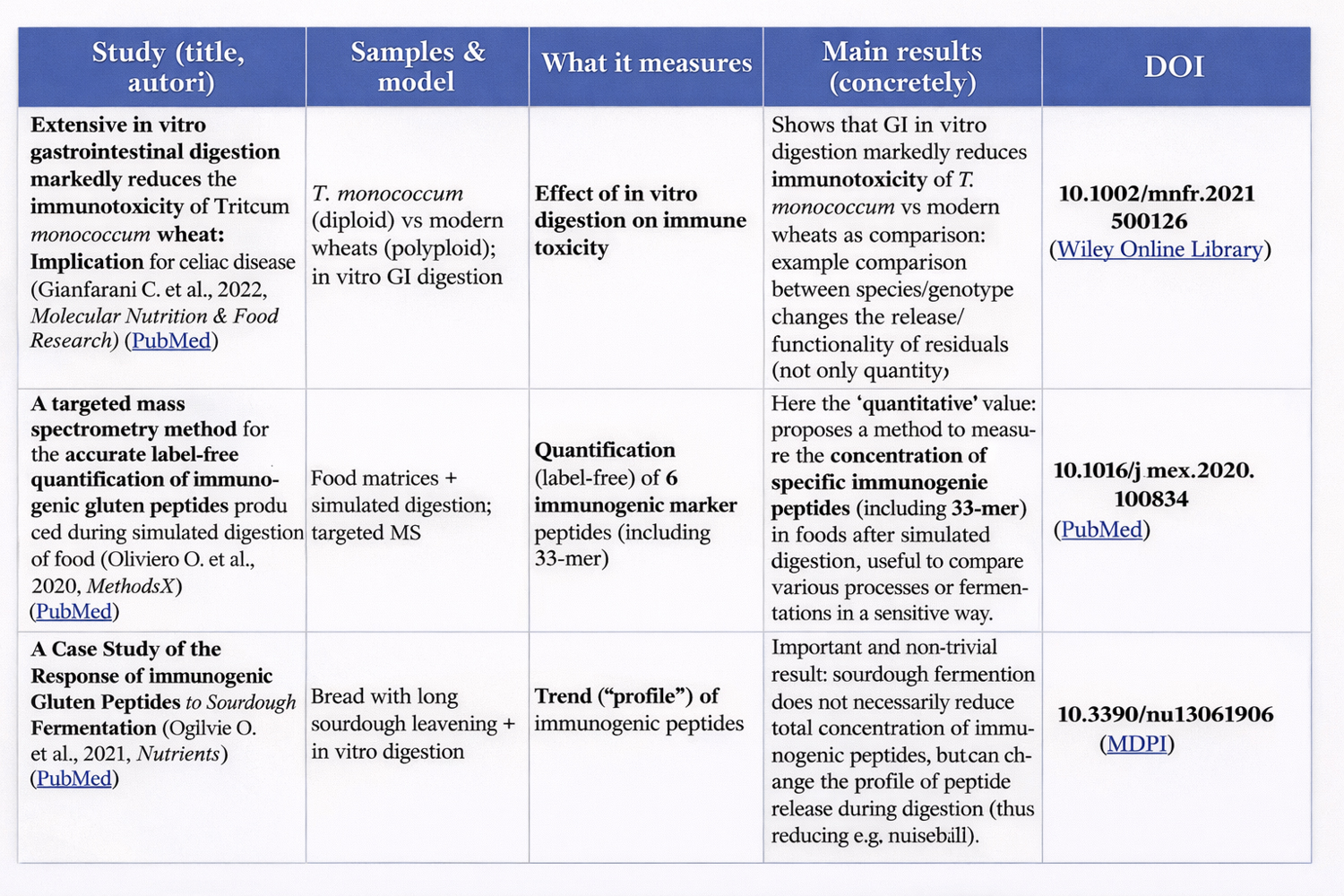
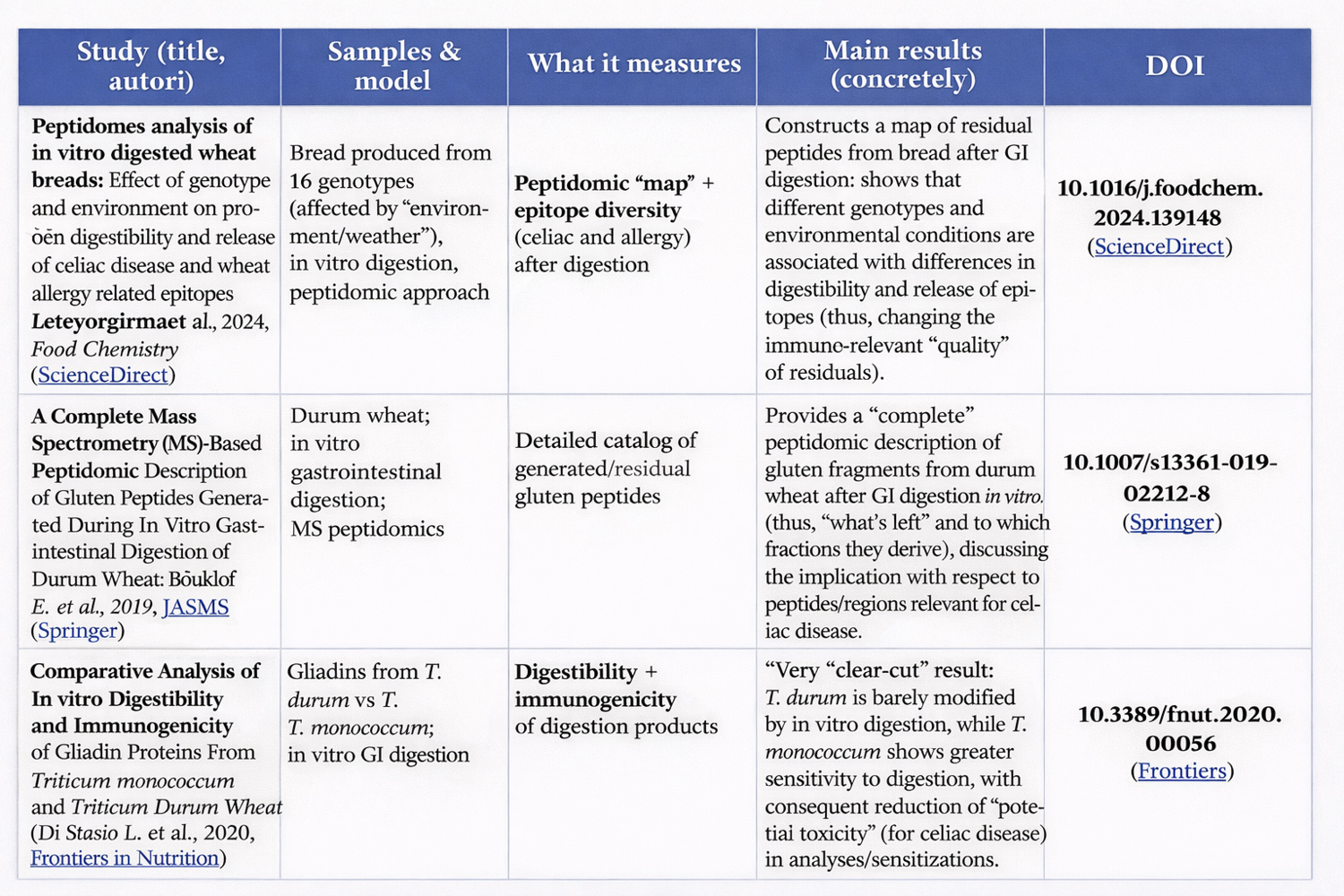
The 2020 Ogilvie study is often used as a “tool” to put numbers (quantities) on peptide markers, whereas Lavoignat 2024 and Boukid 2019 are more peptidomic “atlases” (quality/type + epitopes).
Di Stasio 2020 and Gianfrani 2015 are excellent for the “wheat diversity → different digestibility/immunogenicity” aspect.
Methodological framework (what “complete digestion” means in a standard way)
Many works use or are inspired by the INFOGEST protocol (international standard), which makes results comparable across studies:
1 – A standardised static in vitro digestion method suitable for food — an international consensus (Minekus M. et al., 2014, Food & Function) — DOI: 10.1039/C3FO60702J
2 – INFOGEST static in vitro simulation of gastrointestinal food digestion (Brodkorb A. et al., 2019, Nature Protocols) — DOI: 10.1038/s41596-018-0119-1
Concluding message to include
The response to gluten exposure does not depend on a single factor (e.g., “gluten strength” or “ancient vs modern wheat”), but on the combination of genotype/species, matrix and technological process, and above all on the final profile of residual peptides after digestion: which peptides (type), how many (abundance/markers), and how immuno-relevant they are (epitopes).
Peptidomic studies and targeted quantification studies show that both composition and release patterns of peptides change as a function of wheat type and processing.

Back