
Undigested Food → Low-Grade Intestinal Inflammation → Increased Intestinal Permeability
(Related Article No. 3 – Series: Irritable Bowel Syndrome (IBS) and Intestinal Permeability)
Introduction
Recent scientific literature suggests that the presence of incompletely digested food within the intestinal lumen may, in specific contexts, contribute to low-grade chronic inflammatory processes and to increased intestinal permeability.
This relationship emerges particularly from the review by Riccio and Rossano (2019), which proposes that undigested food residues and the intestinal microbiota may cooperate in the pathogenesis of systemic inflammatory conditions, including those with possible neurological manifestations. In this model, loss of intestinal barrier integrity allows the passage of luminal molecules—food fragments, peptides, endotoxins, and microbial components—into the internal compartment, thereby promoting immune activation.
From this perspective, digestion is not merely a nutritional process, but also a fundamental biological defense mechanism.
The Concept of Dietary “Non-Self”
Before complete digestion, food retains a biological identity distinct from that of the host organism.
According to Riccio and Rossano:
Intact or partially digested food is biologically perceived as “non-self”
Only after complete breakdown into simple molecules (amino acids, monosaccharides, fatty acids) does it become “self”
The intestinal barrier therefore plays a crucial role in preventing the systemic passage of structurally complex material.
When this containment system weakens, partially digested food fragments may cross the epithelium and contribute to:
Intestinal inflammation
Chronic immune activation
Alterations of the microbiota
Potential systemic effects
Gastric Digestion as the First Level of Protection
Gastric digestion represents the first major filter against dietary antigenic load.
1. Protein Fragmentation
The acidic environment of the stomach:
Denatures proteins
Activates pepsin
Produces smaller, more manageable peptides
The more extensively proteins are hydrolyzed early, the smaller the amount of complex fragments reaching the small intestine.
This is relevant because: Macromolecular proteins are more immunogenic
Large peptides can interact with the mucosa
Excess protein residues increase intestinal digestive burden
2. Support of the Enzymatic Cascade
Adequate gastric acidity promotes efficient activation of pancreatic proteases (trypsin, chymotrypsin, elastase, carboxypeptidases).
If gastric digestion is inefficient:
Downstream enzymatic activity is reduced
The probability of incompletely degraded protein residues increases
Thus, the stomach functions as both a mechanical and chemical filter that reduces mucosal exposure to potentially immunogenic molecules.
Incomplete Digestion and Intestinal Permeability
When larger quantities of complex peptides reach the intestine:
Interaction with the epithelium increases
In the presence of a weakened barrier, the probability of translocation rises
Local immune activation is promoted
In “leaky gut” models, this is associated with:
Alterations of tight junctions
Increased paracellular permeability
Passage of peptides, endotoxins, and antigens
This may generate a vicious cycle:
Inefficient digestion → increased antigenic load → mucosal stress → increased permeability → increased inflammation
The Special Case of Gluten
Gluten represents a well-studied example of a partially digestible dietary protein.
Reviews by Cenni et al. (2023) and other studies show that:
Gluten is rich in proline and glutamine
Human digestion generates enzyme-resistant peptides
Some of these peptides can alter tight junctions via zonulin
In predisposed individuals (celiac disease, non-celiac gluten sensitivity):
Gluten peptides increase intestinal permeability
Facilitate bacterial translocation
Activate mucosal immune responses
It is important to emphasize that:
The human digestive system possesses proteases capable of degrading many gluten peptides
Nevertheless, some highly immunogenic fragments may persist
Therefore, gluten is not universally pathogenic, but may become clinically relevant in vulnerable contexts.
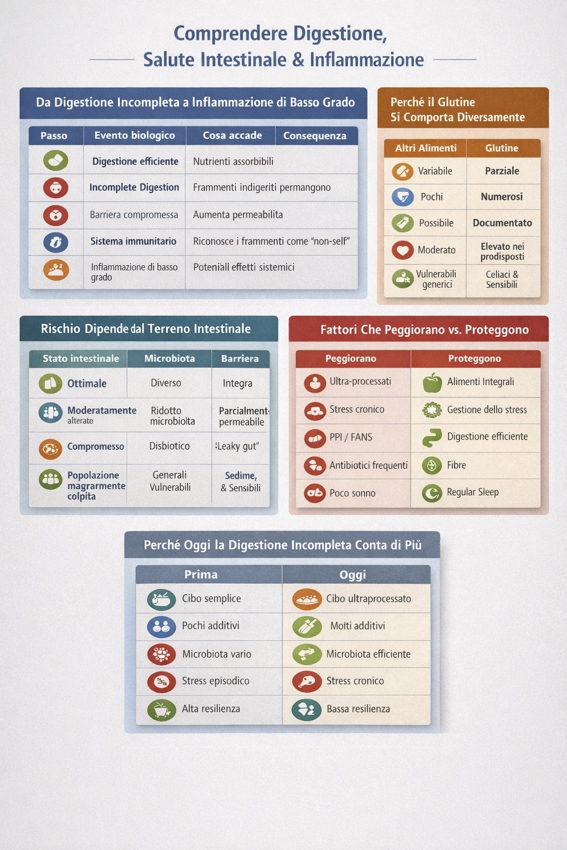
Why These Mechanisms Are Irrelevant in “Healthy” Individuals
Under ideal physiological conditions:
Intact intestinal barrier
Diverse and resilient microbiota
Efficient digestion
Tolerant immune system
Food residues are eliminated without consequences.
However, individuals who truly meet all these conditions are becoming increasingly rare.
Modern Factors That Reduce Intestinal Resilience
(and why “healthy” individuals are becoming rare)
Modern medicine increasingly recognizes that most people are chronically exposed to factors that reduce intestinal and systemic resilience:
Ultra-processed foods → dysbiosis and inflammation
Pesticides and plasticizers → endocrine and immune interference
Chronic stress → reduced digestive secretions, increased permeability
Common medications (NSAIDs, PPIs, antibiotics, artificial sweeteners) → mucosal and microbial damage
Environmental pollutants and heavy metals → immune and microbial alterations
Disrupted circadian rhythms → inflammatory and metabolic effects
The cumulative burden of these factors:
Weakens the mucosa
Reduces digestive efficiency
Modifies the microbiota
Increases immune reactivity
Incomplete Digestion Matters More Today
Under ideal conditions, food residues (including gluten peptides) reach the colon and are fermented, neutralized, or eliminated.
However, in the context of the cumulative stressors described above, these residues may acquire clinical relevance.
A Crucial Distinction
This model does not claim that:
Undigested food is a direct cause of disease
Gluten is inherently harmful to everyone
Rather, it proposes a multifactorial paradigm:
**Genetic predisposition
dysbiosis
impaired barrier
environmental stressors
dietary antigenic load
→ loss of resilience → low-grade inflammation**
Final Summary
Efficient digestion reduces intestinal antigenic load
Efficient digestion alone does not guarantee protection
Intestinal health emerges from the interaction between digestion, barrier function, microbiota, and lifestyle
In a modern organism with reduced biological resilience, even seemingly simple processes such as incomplete digestion may acquire clinical significance
Essential References
1. Gluten and intestinal permeability
Cenni S. et al. – The Role of Gluten in Gastrointestinal Disorders: A Review. Nutrients, 2023.
Review analyzing gluten’s role in gastrointestinal disorders, describing how gluten is only partially digested and generates enzyme-resistant peptides.
✔️ Reports that gluten fragments can modulate intestinal tight junctions (also via zonulin), increase permeability, and promote immune responses, especially in predisposed subjects.
2. Undigested food and microbiota in inflammatory pathogenesis
Riccio P., Rossano R. – Undigested Food and Gut Microbiota May Cooperate in the Pathogenesis of Neuroinflammatory Diseases. Nutrients, 2019.
Review proposing a model in which undigested food residues and dysbiosis cooperate in promoting intestinal permeability and low-grade chronic inflammation.
✔️ Emphasizes that a weakened barrier allows passage of food fragments, microbial components, and endotoxins, with potential systemic effects.
3. General mechanisms of intestinal permeability (leaky gut)
Intestinal permeability disturbances: causes, diseases and therapy.
Clinical review focusing on regulation of the intestinal barrier, with emphasis on tight junctions (occludin, claudins, ZO proteins) and factors that alter their function.
✔️ Describes how barrier dysfunction promotes local and systemic inflammation.
4. Celiac disease and intestinal barrier impairment
Coeliac disease and the intestinal barrier: mechanisms of disruption and strategies for restoration.
Review analyzing how gluten peptides in genetically predisposed individuals activate immune responses capable of damaging the intestinal barrier.
✔️ Highlights the role of zonulin, tight junctions, and mucosal inflammation in pathogenesis.
5. Human enzymatic capacity for gluten digestion
The human digestive tract has proteases capable of gluten hydrolysis.
Experimental study showing that several human proteases (elastase, carboxypeptidases, etc.) can hydrolyze numerous gluten peptides.
✔️ Indicates that the digestive system possesses tools to degrade gluten, but that some highly resistant fragments may persist.
6. Microbiota, intestinal barrier, and inflammation
Leaky Gut and the Ingredients That Help Treat It: A Review.
Review linking microbiota composition, metabolite production (e.g., SCFAs), and barrier function.
✔️ Shows that dysbiosis and altered barrier function are associated with increased permeability and inflammation.

Back