Header Image - Gluten Light

Tag Archives

4 Articles

Undigested Food → Low-Grade Intestinal Inflammation → Increased Intestinal Permeability

by luciano

(Related Article No. 3 – Series: Irritable Bowel Syndrome (IBS) and Intestinal Permeability)
Introduction
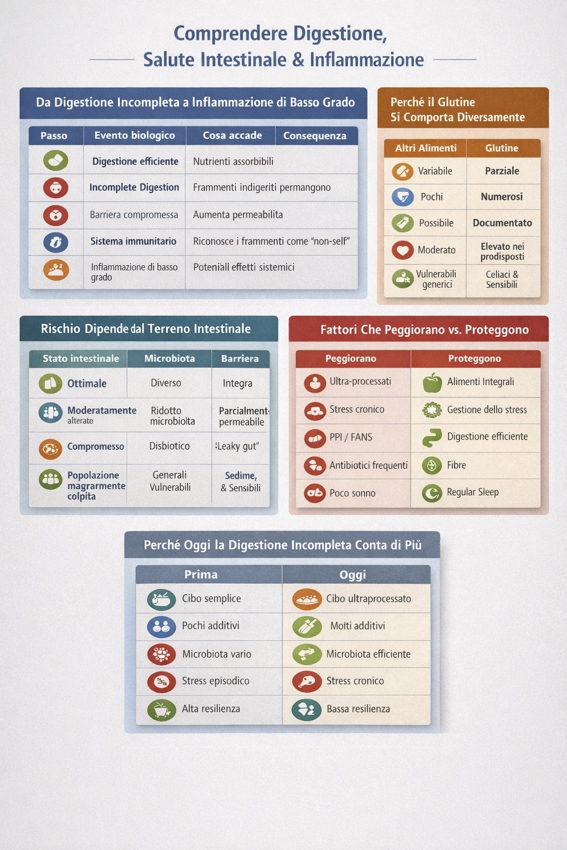
Recent scientific literature suggests that the presence of incompletely digested food within the intestinal lumen may, in specific contexts, contribute to low-grade chronic inflammatory processes and to increased intestinal permeability.
This relationship emerges particularly from the review by Riccio and Rossano (2019), which proposes that undigested food residues and the intestinal microbiota may cooperate in the pathogenesis of systemic inflammatory conditions, including those with possible neurological manifestations. In this model, loss of intestinal barrier integrity allows the passage of luminal molecules—food fragments, peptides, endotoxins, and microbial components—into the internal compartment, thereby promoting immune activation.
From this perspective, digestion is not merely a nutritional process, but also a fundamental biological defense mechanism.

The Concept of Dietary “Non-Self”
Before complete digestion, food retains a biological identity distinct from that of the host organism.
According to Riccio and Rossano:
Intact or partially digested food is biologically perceived as “non-self”
Only after complete breakdown into simple molecules (amino acids, monosaccharides, fatty acids) does it become “self”
The intestinal barrier therefore plays a crucial role in preventing the systemic passage of structurally complex material.
When this containment system weakens, partially digested food fragments may cross the epithelium and contribute to:
Intestinal inflammation
Chronic immune activation
Alterations of the microbiota
Potential systemic effects

Gastric Digestion as the First Level of Protection
Gastric digestion represents the first major filter against dietary antigenic load.
1. Protein Fragmentation
The acidic environment of the stomach:
Denatures proteins
Activates pepsin
Produces smaller, more manageable peptides
The more extensively proteins are hydrolyzed early, the smaller the amount of complex fragments reaching the small intestine.
This is relevant because: Macromolecular proteins are more immunogenic
Large peptides can interact with the mucosa
Excess protein residues increase intestinal digestive burden
2. Support of the Enzymatic Cascade
Adequate gastric acidity promotes efficient activation of pancreatic proteases (trypsin, chymotrypsin, elastase, carboxypeptidases).
If gastric digestion is inefficient:
Downstream enzymatic activity is reduced
The probability of incompletely degraded protein residues increases
Thus, the stomach functions as both a mechanical and chemical filter that reduces mucosal exposure to potentially immunogenic molecules.

Incomplete Digestion and Intestinal Permeability
When larger quantities of complex peptides reach the intestine:
Interaction with the epithelium increases
In the presence of a weakened barrier, the probability of translocation rises
Local immune activation is promoted
In “leaky gut” models, this is associated with:
Alterations of tight junctions
Increased paracellular permeability
Passage of peptides, endotoxins, and antigens
This may generate a vicious cycle:
Inefficient digestion → increased antigenic load → mucosal stress → increased permeability → increased inflammation

The Special Case of Gluten
Gluten represents a well-studied example of a partially digestible dietary protein.
Reviews by Cenni et al. (2023) and other studies show that:
Gluten is rich in proline and glutamine
Human digestion generates enzyme-resistant peptides
Some of these peptides can alter tight junctions via zonulin
In predisposed individuals (celiac disease, non-celiac gluten sensitivity):
Gluten peptides increase intestinal permeability
Facilitate bacterial translocation
Activate mucosal immune responses
It is important to emphasize that:
The human digestive system possesses proteases capable of degrading many gluten peptides
Nevertheless, some highly immunogenic fragments may persist
Therefore, gluten is not universally pathogenic, but may become clinically relevant in vulnerable contexts.
 

Gluten and “toxic” fractions (part I)

by luciano

– the structure of the gliadin and the toxicity of some fraction –
Gluten which is a protein compound formed by the prolamine, known as gliadin in wheat and responsible for the main phenomena of adverse reactions, and glutenin present mainly in the endosperm of cereal caryopsis such as wheat, spelled, rye and barley. Gluten is formed when water, flour and yeast are mixed: gliadin and glutenin combine to form a mixture characterized by viscosity, elasticity and cohesion. Therefore the quantity and integrity of the proteins that make up the gluten present in a flour are an important index to evaluate the quality and aptitude for baking.
Gliadin and glutenin, therefore, have been the subject of numerous research both in relation to the properties concerning the rheological characteristics of the doughs and to the adverse reactions that activate the immune system. Studies have been carried out on celiac disease that have discovered who and how this pathology is caused: they are some peptides (a set of amino acids) present, especially in the gliadin that contain sequences that are toxic, ie they activate the adverse reaction in genetically predisposed subjects of the immune system. The gliadin, in turn, is composed of several sub-units and these contain the “toxic” fractions in different quantities and qualities. Not only has William Hekkins’ research highlighted how the shape and location of gliadin molecules also influence not only chemical and physical properties but also toxicity.
“The gliadin proteins are heterogenous in different regions of the molecule and consequently differ in phisical and chemical properties. About 35% of the gliadin molecule is the alfa helix form, whereas 35% are beta turns(5). The latter are concentrated in the N terminal and C terminal more apolar parts of the gliadin. The remaining part has a random structure. These form have conseguences for the immunogenecity of the different regions in the molecule. Especially beta-turns are immunogenic.” The Toxicity of wheat prolamins William TH. J. M. Hekkens Annales Nestlé 1995 n. 51.
The study also analyzed the mechanism underlying the toxicity by detecting how “the passage of undigested gliadin fragments (fragments longer than 8 amino acids) or a lower tolerance to gliadin causes the immune system to react”. It is not enough, therefore, to know how much gliadin is present in a grain, but it is necessary to have the complete screening of its sub-units (quality, quantity, and, according to the study mentioned also form and position). The study on the “structure of gliadin” could partly explain why some ancient grains (for example, the monococcus), despite having a quantity of gliadin (and in particular alpha gliadin) not inferior to modern grains, have almost zero toxic levels.
Depeening:
The Toxicity of wheat prolamins

Celiac disease: gluten-free foods that are not always healthy, especially those for children 2017

by luciano

Confrontati 654 prodotti gluten-free con equivalenti contenenti glutine. Nei primi troppi grassi, poche proteine e zuccheri. L’allarme dei nutrizionisti: “Inducono ad una dieta sbilanciata, le confezioni ingannano e i ragazzini celiaci rischiano obesità” di AGNESE FERRARA Repubblica.it. 15-Maggio-2017

GLI ALIMENTI senza glutine non sarebbero così salutari come sembra. L’ennesima conferma (con tanto di prove) arriva dai nutrizionisti della Società europea di gastroenterologia, epatologia e nutrizione pediatrica (Espghan) riuniti a Praga per il 50esimo congresso. I ricercatori hanno confrontato 654 prodotti gluten-free come pane, pasta, pizza, farine e biscotti di 25 marche diverse, con gli equivalenti che invece contengono il glutine. I risultati dell’analisi sono stati presentati oggi al congresso. I grassi. “Complessivamente i diversi tipi di pane senza glutine avevano un livello molto maggiore di grassi e acidi grassi saturi, le paste un più basso contenuto di proteine e zuccheri e i biscotti un minimo contenuto di proteine e troppi lipidi. Il pane, la pasta e le farine con il glutine, invece, hanno un contenuto 3 volte maggiore di proteine rispetto ai loro sostituti gluten-free”, spiegano gli esperti dell’Espghan.

LEGGI Sei milioni di italiani consumano cibo per intolleranti senza esserlo

L’appello degli esperti. Gli scienziati riuniti a Praga hanno lanciato un appello affinché questa tipologia di cibi sia riformulata con materie prime più salutari per assicurare una nutrizione più sana, soprattutto durante l’infanzia. “L’intolleranza al glutine colpisce l’1% della popolazione europei e una dieta senza glutine va seguita per tutta la vita, – spiega Joaquim Calvo Lerma, del gruppo di ricerca sulla celiachia e immunopatologia digestiva all’Instituto de Investigation Sanitaria La Fe a Valencia, in Spagna, a capo dell’indagine. “Inoltre un numero sempre crescente di persone mangia senza glutine perché convinta sia più salutare, anche se non sono affetti da celiachia. E’ imperativo che il mercato dei cibi sostitutivi sia riformulato per assicurare che tali alimenti siano uguali agli altri dal punto di vista nutrizionale. Ciò è particolarmente importante per i bambini perché una dieta così sbilanciata influenza il loro sviluppo e aumenta il rischio di obesità durante l’infanzia”. La legislazione. Sulla questione interviene Daciana Sarbu, vice direttore del comitato per l’ambiente, la salute pubblica e la sicurezza alimentare al Parlamento Europeo. “La legislazione europea prevede l’etichettatura nutrizionale obbligatoria anche per gli alimenti gluten-free preconfezionati – spiega – .Tuttavia i prodotti alimentari non pre-imballati, come il pane o le pizze senza glutine, non sono soggetti agli stessi requisiti di etichettatura. In questo caso, i consumatori potrebbero essere meno consapevoli delle importanti differenze nutrizionali con impatti sanitari potenzialmente significativi”.

Le proteine. “Il dato è noto in pediatria sia ai nutrizionisti che ai gastroenterologi, – commenta Andrea Vania, pediatra nutrizionista al dipartimento di pediatria Sapienza- Università di Roma – .Per rendere più appetibili gli alimenti gluten-free e simili agli altri le industrie impiegano una quota più elevata di grassi, in particolare nei prodotti come biscotti, merende e biscotti da tè. Il calo delle proteine, invece, è inevitabile perché il glutine è la proteina che permette al pane di essere pianificato e alla pasta di tenera la cottura. Levandolo, la percentuale di proteine cala ma questo aspetto preoccupa molto meno perché la nostra alimentazione contiene già troppe proteine e zuccheri e il rischio di deficit nei bambini è molto raro”.

Cosa fare. Cosa fare allora se il proprio figlio o figlio è celiaco?. “E’ bene che tali prodotti vengano riformulati – precisa Vania – ma nel frattempo il consiglio che do ai genitori di bambini con celiachia è di cucinare il più possibile a casa i cibi gluten free, usando solo ingredienti sani e privi di glutine, senza grassi e addensanti in più. Le ricette sono davvero molte e si trovano anche nel web. Si possono fare la pasta fresca, i biscotti, i dolci farciti con l’uso di creme fatte con la fecola di patate o maizena. Ci sono molti ingredienti alternativi, come l’amido di mais e la fecola di patate, privi di glutine e senza grassi in eccesso”.

Repubblica.it 2017