Header Image - Gluten Light

Tag Archives

3 Articles

Residual wheat peptides after complete in vitro digestion: type, amount, immunogenicity (and why wheat diversity matters)

by luciano

(in-depth focus 5 of Genetic potential and processing conditions in determining gluten strength, digestibility, and immunogenicity)

Simulated gastrointestinal digestion and gluten residues
The studies reported below show that, after simulated gastrointestinal digestion, there is not a single “gluten residue,” but rather a peptide profile (“fingerprint”) that varies as a function of:

1 – species/genotype (wheat diversity),
2 – food matrix (flour/bread, etc.),
3 – processing (fermentation, leavening, baking),
4 – digestion conditions (protocol and kinetics),
5 – and type/abundance of epitopes (celiac disease / allergy).
This truly allows one to “build a picture” of how wheat diversity influences digestion and immuno-relevant potential.

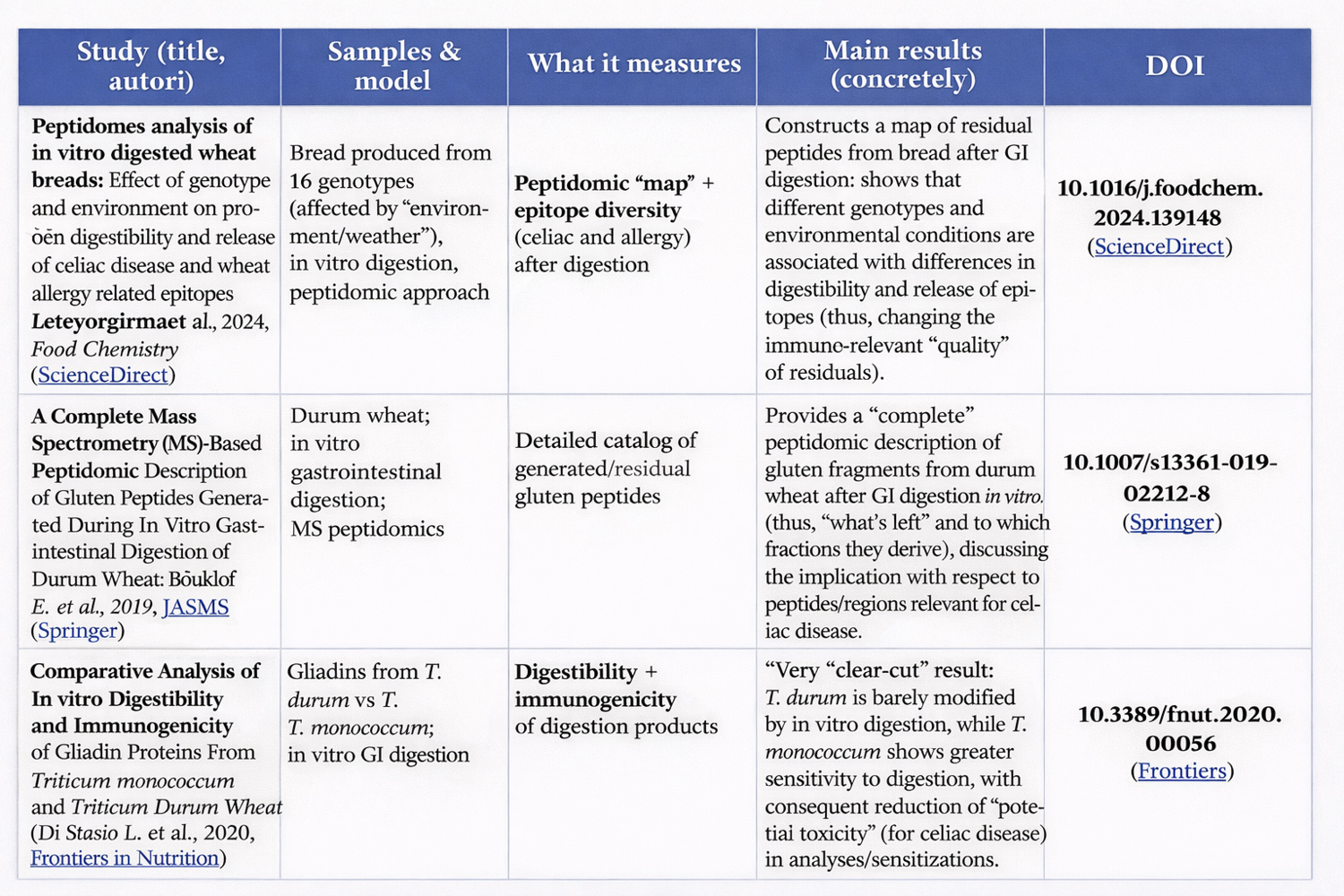
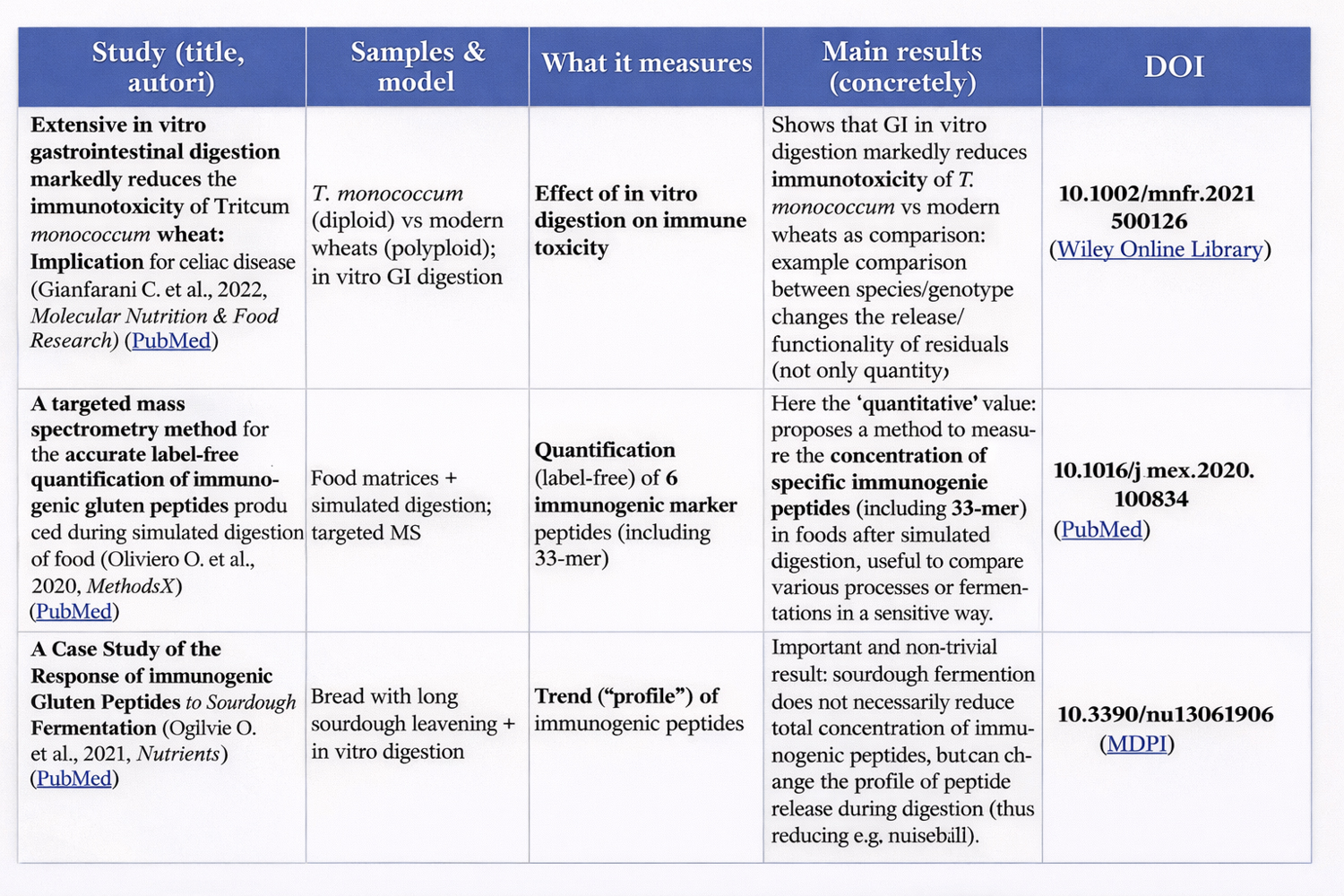
Key studies (with concrete results)

Practical note
The 2020 Ogilvie study is often used as a “tool” to put numbers (quantities) on peptide markers, whereas Lavoignat 2024 and Boukid 2019 are more peptidomic “atlases” (quality/type + epitopes).
Di Stasio 2020 and Gianfrani 2015 are excellent for the “wheat diversity → different digestibility/immunogenicity” aspect.

Methodological framework (what “complete digestion” means in a standard way)
Many works use or are inspired by the INFOGEST protocol (international standard), which makes results comparable across studies:

1 – A standardised static in vitro digestion method suitable for food — an international consensus (Minekus M. et al., 2014, Food & Function) — DOI: 10.1039/C3FO60702J
2 – INFOGEST static in vitro simulation of gastrointestinal food digestion (Brodkorb A. et al., 2019, Nature Protocols) — DOI: 10.1038/s41596-018-0119-1
Concluding message to include
The response to gluten exposure does not depend on a single factor (e.g., “gluten strength” or “ancient vs modern wheat”), but on the combination of genotype/species, matrix and technological process, and above all on the final profile of residual peptides after digestion: which peptides (type), how many (abundance/markers), and how immuno-relevant they are (epitopes).

Peptidomic studies and targeted quantification studies show that both composition and release patterns of peptides change as a function of wheat type and processing.

Immunogenicity and resistance to digestion in gluten (and why they do not always coincide)

by luciano

(In-depth article 6 of: Genetic potential and processing conditions in determining gluten strength, digestibility, and immunogenicity)

In gluten (especially gliadins and, partly, glutenins) there is a strong overlap between:

  • resistance to gastrointestinal digestion

  • immunogenic potential (especially in celiac disease)

but the two concepts are not equivalent: resistance is often a facilitating condition, whereas immunogenicity also requires specific rules of immunological recognition.

1) Why many immunogenic sequences are also resistant

The most “problematic” regions of gluten are rich in proline (P) and glutamine (Q). This profile:

  • hampers cleavage by the main human proteases (pepsin, trypsin, chymotrypsin), which have low ability to cut near proline;

  • favors the persistence of long oligopeptides (10–30+ aa) in the intestinal lumen.

This point is well described in reviews and experimental studies on gluten digestion and on the persistence of peptides such as the 33-mer. (Cambridge University Press & Assessment)

2) Why resistance increases the probability of “remaining immunogenic” after digestion

A peptide that resists digestion:

  • remains long enough to contain complete epitopes (or multiple overlapping epitopes);

  • can generate, through partial cleavage, sub-fragments that still retain recognizable sequences.

In other words: it is not just “surviving” digestion, but surviving while maintaining sequence motifs compatible with immune presentation.

Peptidomic/in vitro digestion studies on wheat products show that the residual peptide profile often includes regions known for epitope density and resistance. (ScienceDirect)

3) What makes a peptide truly immunogenic (beyond resistance)

To trigger a T-cell response in celiac disease, a peptide must:

  1. be presentable by HLA-DQ2/DQ8 (sequence constraints and “anchor” residues);

  2. often become more affine through deamidation by tissue transglutaminase (TG2) (conversion of Q→E in specific contexts);

  3. be recognized by specific T cells.

Therefore, it is possible to have highly resistant peptides that nevertheless:

  • do not bind HLA-DQ2/DQ8 efficiently,

  • are not good substrates for TG2, and/or

  • do not correspond to known T-cell epitopes.

A classic reference on HLA-DQ2 presentation of gluten peptides is available on PNAS. (pnas.org)


4) Concrete example: resistant but non-immunogenic peptide

A very useful example (although engineered) is described by Bethune et al.: the authors created analogs of the 33-mer in which some key glutamines are substituted (e.g., NNN-33-mer and HHH-33-mer). These analogs:

  • remain resistant to simulated digestion (pepsin and also duodenal digestion with pancreatic/brush border proteases),

  • but are not appreciably recognized by TG2, HLA-DQ2, or celiac-specific T cells.

This experimentally demonstrates that resistance to digestion ≠ immunogenicity, even when length and “proline-richness” remain similar. (PMC)

Note: this is a “clean” example because it preserves the resistance feature while breaking (through targeted modifications) the immunological recognition requirements.

5) Summary

Immunogenic gluten sequences tend to be overrepresented among digestion-resistant fragments because resistance allows the persistence of sufficiently long, epitope-rich peptides; however, immunogenicity also requires compatibility with HLA-DQ2/DQ8 presentation and often TG2-mediated modification (deamidation).

Further discussion

So far, the genetic and technological variability of the entire pool of digestion-resistant fragments has not been explored in a systematic and in-depth manner, because most studies focus on known immunogenic peptides rather than on the complete repertoire of proteolysis-resistant fragments in relation to genotype/process. (Frontiers)

Read more

Key evidence-supported points:

1. Peptidomic studies show richness of resistant peptides, but rarely investigate non-immunogenic ones

Analyses based on simulated digestion and mass spectrometry (LC-MS/MS) reveal hundreds or thousands of peptides after gluten digestion. Only a minority of these coincide with known immunogenic epitopes; most resistant peptides identified in digests are not directly associated with immunogenicity in published studies. (Frontiers)

2. The prevailing interpretation is still “epitope-focused”

Recent literature summarizes the state of the art of methodologies to assess potential immunogenicity (digestion + peptide profiling); however, these reviews also underline that analytical techniques tend to isolate and quantify immunogenic epitopes rather than delineate a complete catalog of persistent, non-immunogenic peptides. (Frontiers)

3. Genotypic variability has been analyzed, but with focus on immunogenic epitopes

Studies on different wheat genotypes show that:

  • digestion and peptide-release profiles vary with genotype,

  • some genotypes show differences in the amount of immunogenic epitopes released,

  • but the pool of resistant non-immunogenic peptides is rarely systematically characterized. (ScienceDirect)

This means that, even though very large peptidomic datasets exist, studies have so far not exploited the “non-immunogenic” component—i.e., digestion-resistant residues lacking immune-presentation motifs—as an object of genotypic and technological comparison aimed at reducing overall biological impact.

4. Research concentrates on clinically relevant immunogenicity

Much of the literature (and analytical strategies) focuses on identification or quantification of so-called Gluten Immunogenic Peptides (GIP), which are fragments detectable in digests and biological matrices that correlate with immune responses in celiac patients and also serve as diagnostic/monitoring markers. (ResearchGate)

This directs attention toward what activates the immune system rather than toward the full profile of non-activating fragments.

Summary

✔ Digestion-resistant but non-immunogenic peptides exist in in vitro digests
✔ There are studies that observe them indirectly (as part of the total peptidome)
❌ There is not yet a systematic body of research that:

  • exhaustively maps resistant non-immunogenic peptides,

  • compares this variability among genotypes,

  • explores how different processes (fermentation, enzymes, baking) quantitatively influence the overall pool of resistant peptides.

In other words: research has the tools (in vitro digestion + LC-MS/MS) to do this, and some preliminary data indicate genotypic variability in digestion profiles, but a comprehensive evaluation of the biological weight of resistant non-immunogenic peptides in relation to genotype/technology has not yet been completed. (ScienceDirect)

Useful references

Boukid, F. et al. (2019) – A Complete Mass Spectrometry (MS)-Based Peptidomic Description of Gluten Peptides Generated During In Vitro Gastrointestinal Digestion of Durum Wheat. J. Am. Soc. Mass Spectrom. DOI:10.1007/s13361-019-02212-8 — describes the complete peptidome after digestion of durum wheat, highlighting many resistant sequences without focusing only on immunogenic epitopes. (Springer Nature)

Lavoignat, M. et al. (2024) – Peptidomics analysis of in vitro digested wheat breads: Effect of genotype and environment on protein digestibility and release of celiac disease and wheat allergy related epitopes — lays the groundwork for studying genotypic variability in production of resistant peptides and epitopes, but does not yet provide an exhaustive classification of non-immunogenic ones. (ScienceDirect)

Mamone, G. et al. (2023) – Analytical and functional approaches to assess the immunogenicity potential of gluten proteins. Front. Nutr. — methodological review reflecting the current epitope-oriented approach. (Frontiers)

Concise conclusion

Robust peptidomic data show the abundance of proteolysis-resistant fragments in digested gluten; however, the literature has so far prioritized identification and quantification of immunogenic peptides only, leaving largely unexplored the genetic and technological variability in the overall production of resistant non-immunogenic residues and their possible biological role. (Frontiers)

The 33-mer Peptide — Why It Is a Fundamental Reference

by luciano

(Insight 2 of “Genetic Potential and Processing Conditions in the Determination of Gluten Strength, Digestibility, and Immunogenicity”)

The 33-mer peptide (sequence LQLQPFPQPQLPYPQPQLPYPQPQLPYPQPQPF) is recognized as one of the most digestion-resistant peptides derived from gluten proteins and as one of the main stimulators of T cells in the context of celiac disease.

Its importance stems from three key characteristics:

1 – Enzymatic resistance
Its high content of proline and glutamine makes it highly resistant to human digestive enzymes (pepsin, trypsin, chymotrypsin), allowing it to persist in the intestinal lumen after both in vitro and in vivo digestion.
2 – High immunogenicity
It contains multiple regions (epitopes) recognized by T cells from patients with celiac disease and was among the first peptides identified with this property.
3 – resence in common wheat species
It is present in most common hexaploid wheats (T. aestivum) and in spelt, but has been reported as absent in tetraploid/diploid wheats lacking the D genome (such as durum wheat, emmer, and einkorn).
For these reasons, the 33-mer peptide is frequently used as a marker for assessing “gluten immunogenicity” in flours and food products and for comparing wheat cultivars in research focused on immune response.

Key Findings from Studies on the 33-mer Peptide. Shan et al. (2002) — Identification and Immunogenicity of the 33-mer. Title: A resistant peptide from gliadin that is a potent activator of intestinal T cells in celiac disease. Authors: Shan L., Molberg Ø., Parrot I., Hausch F., Filiz F., Gray G.M., Sollid L.M., Khosla C. Journal: Science (2002). DOI: 10.1126/science.1074624

Core finding:
This landmark study isolated and characterized the 33-mer peptide as one of the most potent activators of T cells in celiac patients and demonstrated its extreme resistance to standard proteolytic digestion, confirming its immunogenic relevance.

Vader et al. (2002) — Structure and Epitopes of the 33-mer. Title: Structural basis for gluten intolerance in celiac sprue. Authors: Vader W., Stepniak D., Bunnik E., et al. Journal: Journal of Experimental Medicine (2002)
DOI: 10.1084/jem.20020609

Core finding:
Mapping of the major immunogenic epitopes within gliadins, explaining why sequences such as the 33-mer—with multiple and overlapping epitopes—are particularly active in triggering immune responses.

Schalk et al. (2017) — Quantification and Distribution of the 33-mer in Wheat. Title: Quantitation of the immunodominant 33-mer peptide from α-gliadin in wheat flours by liquid chromatography tandem mass spectrometry. Authors: Kathrin Schalk, Christina Lang, Herbert Wieser, Peter Koehler, Katharina Anne Scherf. Journal: Scientific Reports (2017). DOI: 10.1038/srep45092

Core finding:

This study measured the 33-mer content in a wide range of modern and ancient wheat flours using a targeted method (SIDA + LC-MS/MS), providing important data on variability among wheat genotypes.

Specific Findings from Schalk et al. (2017)

General overview:

The 33-mer peptide was detected in all common wheat (hexaploid) and spelt flours analyzed.
Reported values ranged approximately from 90.9 μg/g to 602.6 μg/g of flour.
The peptide was not detected (below limit of detection) in cereals lacking the D genome such as durum wheat, emmer, and einkorn, consistent with the absence of α2-gliadins encoding this peptide.
Interpretation:
The observed variability indicates that even within closely related wheat types, the amount of 33-mer peptide can differ substantially. This suggests that genotype and cultivar variation have a tangible impact on the content of celiac-related immunogenic peptides.

Related and Complementary Evidence

Norwig et al. (2024) confirm the presence of the 33-mer in all analyzed common wheat and spelt samples, reinforcing its central role in gluten-related peptidomic research.
Broader proteomic and peptidomic approaches show that the 33-mer is only one of several immunogenic peptides that can persist after digestion, but it remains a robust marker for comparing genotypes and technological processes (fermentation, baking, etc.).
Explanatory Box — Main Results from Schalk et al. (2017)

33-mer peptide content (μg/g flour) in analyzed wheats:

Minimum observed value: ~90.9 μg/g
Maximum observed value: ~602.6 μg/g
Typical distribution: most samples fall in the 200–400 μg/g range
Absence: not detected in durum wheat, emmer, and einkorn, likely due to the lack of D-genome α2-gliadin.

Why This Subsection Completes the Big Picture
Starting from a clear biological concept (resistance + immunogenicity), this subsection connects:

Molecular mechanisms (multiple epitopes within a single peptide),
Classical experimental evidence,
Real quantitative data across different cultivars,
Consistency with variability observed in broader peptidomic studies.
This provides readers with a solid framework to understand not only that the 33-mer exists, but why its presence and quantity vary among wheats and why it matters for digestion and immune response.

Keywords: 33-mer peptide, gluten immunogenicity, celiac disease gluten peptides, α-gliadin peptides, digestion-resistant gluten peptides, wheat cultivars immunogenicity, gluten T-cell epitopes, gluten peptidomics, wheat genetics and celiac disease, gluten digestibility