(Related article no. 2: Irritable Bowel Syndrome (IBS) and Intestinal Permeability)
1. Introduction
Irritable Bowel Syndrome (IBS) is a chronic functional disorder of the gastrointestinal tract characterized by abdominal pain and altered bowel habits, in the absence of evident structural abnormalities. It is classified as a Disorder of Gut–Brain Interaction (DGBI) and presents heterogeneous clinical phenotypes.
2. Intestinal Permeability and IBS: Scientific Evidence
2.1 Clinical Review on Intestinal Permeability
“Intestinal barrier dysfunction in irritable bowel syndrome: a systematic review”
Hanning et al. (2021) — Review of 66 studies on the role of the intestinal barrier in IBS.
Summary: Increased intestinal permeability is observed in a significant proportion of IBS patients, particularly in diarrhea-predominant (IBS-D) and post-infectious IBS (PI-IBS), while it is less frequent in constipation-predominant IBS (IBS-C) and nearly absent in mixed IBS (IBS-M). Increased permeability is also associated with greater symptom severity. (PubMed)
2.2 Correlations Between Permeability and Clinical Factors
Anthropometric studies and challenge tests indicate that increased permeability is frequently associated with:
Alterations in tight junction proteins (e.g., occludin, ZO-1)
Visceral hypersensitivity
Local and systemic inflammatory markers
(as shown in reviews on IBS and other gastrointestinal models) (Springer Nature)
3. Intestinal Permeability and Low-Grade Chronic Inflammation
3.1 General Concept and Proposed Mechanisms
“Gut microbiota, intestinal permeability, and systemic inflammation: a narrative review”
Di Vincenzo et al. (2023)
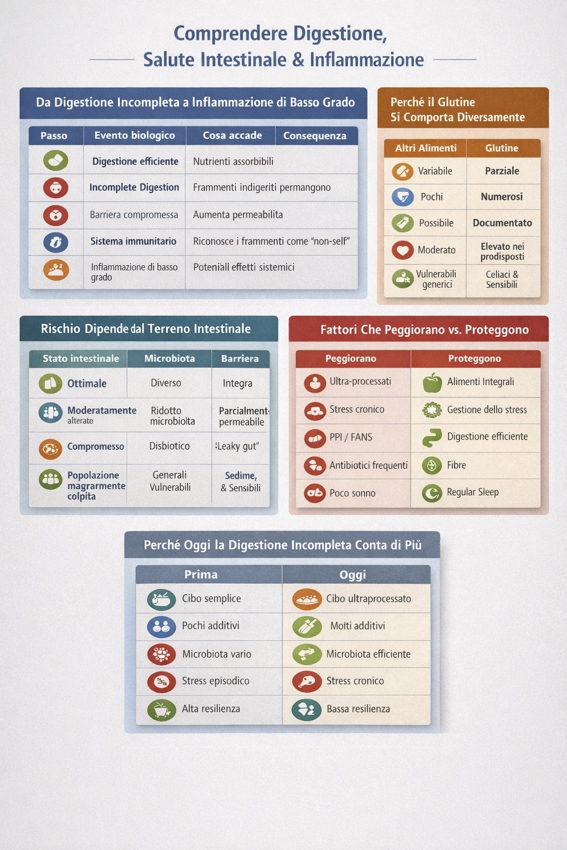
Summary: The intestinal barrier is a dynamic system integrated with the microbiota, nutrients, and immune system. Increased permeability (“leaky gut”) may facilitate the interaction between luminal antigens and immune cells, triggering pro-inflammatory activation. (MedNews Care)
3.2 Interaction Between Inflammation and Barrier Function
“Intestinal permeability – a new target for disease prevention and therapy”
BMC Gastroenterology
Summary: Barrier dysfunction is associated with low-grade inflammation, visceral sensitivity, and IBS symptoms. Local inflammation may contribute to degradation of tight junction proteins, promoting a self-perpetuating cycle of permeability and inflammation. (SpringerLink)
3.3 Bibliometrics and Research Trends
“Mapping research trends on intestinal permeability in IBS …”
Recent bibliometric analysis
Summary: There is growing research interest in microbiota, diet, intestinal permeability, and inflammation in IBS. Interactions among the intestinal barrier, microbiome, and nutritional/environmental factors represent major emerging topics. (PubMed)
4. Low-Grade Inflammation in IBS and Its Relationship with Permeability
4.1 Inflammatory Markers in IBS
Preview of meta-analysis (Digestive Diseases and Sciences, 2025)
Summary: Pro-inflammatory cytokines such as IL-6 and TNF-α are frequently elevated in IBS patients, together with intestinal dysbiosis, suggesting chronic immune activation. (Springer Nature)
4.2 Relationship Between Inflammation and Permeability
“Increased Intestinal Permeability and Decreased Barrier Function: Does It Really Influence the Risk of Inflammation?”
Summary: Although increased permeability is associated with inflammatory markers in several diseases, a mandatory causal relationship is not demonstrated. Permeability may accompany inflammation but does not inevitably generate it. (PubMed)
5. Synthesis: IBS Is Multifactorial — Permeability Is Not Mandatory
Main points of consensus:
1. Many IBS patients exhibit increased permeability, particularly IBS-D and PI-IBS, but many do not.
2. Low-grade chronic inflammation is common in IBS but not always accompanied by increased permeability.
3. Inflammation may contribute to barrier dysfunction, yet IBS-like symptoms can occur with normal permeability.
Emerging consensus model:
Intestinal permeability acts as a pathogenic amplifier in specific IBS subgroups, interacting with microbiota, diet, stress, and immune function, but it is not a universal prerequisite.
6. Examples of Relevant Studies (Rapid Summary)
Hanning et al., 2021 — IBS/barrier systematic review
Di Vincenzo et al., 2023 — Microbiota–permeability–inflammation narrative review
Digestive Diseases and Sciences, 2025 — Inflammation & microbiome meta-analysis
BMC Gastroenterology — Barrier loss, mild inflammation, visceral sensation
Bibliometric analysis — IBS/permeability research trends
7. Conceptual Conclusions
IBS is multifactorial, and its pathophysiology cannot be reduced to a single “barrier defect.”
Increased permeability and low-grade inflammation may co-occur but are not universal.
Their presence depends on clinical phenotype, microbiota composition, immune factors, diet, and psychobiological stress. Clinical assessment should consider biomarkers, microbiota, and immune-barrier interactions, not epithelial integrity alone.