
The old mills with stone millstones are very few and work small batches of wheat, so no industrial plant uses this flour. The good news is that today modern versions of the old mills are also spreading, made up of two stainless steel discs covered with natural stone (the most appreciated is the flint of French La Ferté-sous-Jouarre). Alternatively there are also wheels covered with a mixture of flint, magnesite and emery, similar to that of non-stick pans. With the stone millstones it is impossible to obtain the ’00’ type flour because it is impossible to separate the starch from bran and germ Contrary to the past, the two wheels are housed in a wooden structure and the grains of wheat (or other cereals) are poured from above into the central hole of the disc, which shatters them by rotating at high speed. The difference between natural and artificial stone is that the French millstone rotates at 90-100 rpm, keeping the flour a working temperature around 30 ° C. In the other system the millstones rotate at high speed and the flour overheats, reducing the nutritional properties. The advantage of stone mills (both natural and artificial) is that the flour is ‘truly integral’ because whole grains are ground and in this way the germ and the outer coating (bran) are mixed with the flour, obtaining a flavor, a aroma and superior nutritional properties compared to traditional grinding with cylinders. This flour is rich in fibers, minerals, B vitamins, tocopherols (vitamin E), proteins and fats – polyunsaturated and monounsaturated – present in the bran and germ. Against the best nutritional characteristics, however, there is less conservability due to the presence of the fatty acids of the germ, and a certain resistance to leavening due to the presence of the bran.
Preliminary operations the grinding of wheat : Grain conditioning
Phase in which the grain is wet with a sufficient quantity of water, to facilitate the detachment of the external parts (integuments) from the floury almond and the breaking of the same. The purpose of this phase is to soften the casing to prevent its fragmentation and promote its detachment, to reduce the hardness of the albumen to facilitate its transformation into flour and to obtain a degree of damage to the starch that is optimal for the various uses. . Conditioning is influenced by the amount of water added, the temperature of the treatment and the duration of the rest of the grain.
Stone grinding why?
The choice is motivated by the desire to work flours that preserve all the parts of the grain obtained with a single step. A flour with an irregular granulometry is obtained, with a greater quantity of bran (which gives a darker coloring) and a total conservation of the germ (embryo). Germ preservation is the basic and essential aspect of natural stone milling, since it contains both the most “noble” part of the grain, consisting of antioxidant substances, such as carotenoids (especially zeaxantines and lutein), fat-soluble vitamins (in particular the E), polyphenols, flavonoids, betaine and beta-glucans, which the most “tasty” part, composed of essential oils. The complete blending of the starch with the essential oils contained in the germ gives the flour a fragrance and a richer and fuller aroma. However, the mills must work at low rpm so as not to overheat the flour and compromise its qualities. The stone milling must, however, predict the cleaning and analysis of the grain beforehand. Food safety should be guaranteed, effectively, even before grinding, through analysis on the sanitary quality of the raw material and with a careful cleaning process capable of eliminating not only earth and foreign bodies but also broken and sick beans. With the milling of cylinders and with several passes, the various components of the flour are obtained separately and then reassembled according to certain criteria (especially commercial). Theoretically, therefore, it is possible to obtain with flour the cylinders a flour complete with all the components of the grain as well as that obtained with the stone milling.
Deepening:
1. Preliminary operations the grinding of wheat : Grain conditioning
2. Millstones and millstones with stones
3.Grain milling
4.History of the cereal mill
How to grow organic
Organic cultivation is a method of production that has its basic principles in the care of soil fertility and in the balance of the environment in which it is grown. It is therefore not the substitution of fertilizers, herbicides, fungicides, pesticides in general, with what is admitted by the European regulation, but the correct application of the principles of agro ecology, having as its objective to increase the biodiversity in the soil and the ground for the search for nutritional and environmental balance. The main actions on which it is based are:
• Improve and increase organic fertility – through the use of composted organic fertilizers, the practice of green manure, the burial of crop residues is the inclusion in large rotations of legume crops, in order to increase the quantity and quality of the organic substance of the soil. To support yields and improve the quality of production, it is possible to resort to the list of fertilizers allowed by the regulation;
• Rotation or rotation of crops – is the key to the success of herbaceous and horticultural crops. A Ministry decree indicates that: between a crop and its return on the same land, there is the cultivation of at least two cycles of different crops, of which at least one is composed of legumes or a green manure. This should be considered the minimum certifiable limit, it would be appropriate to diversify as much as possible the type of crops, also to encourage the company biodiversity. The rotation is then the main control element of weeds supplemented by mechanical actions and containment and prevention against pathologies and pests;
• The varietal choice – to date, research has produced and tested very few specific varieties for the organic; it is therefore useful to base oneself on the technical know-how and experience of organic producers in your area, to orient oneself to varieties that have demonstrated adaptability to the territory, ability to compete with weeds and resistance to major adversities. This attention is very valid for new plants of fruit trees and tree crops in general;
• Creation of hedges and trees – useful not only to improve the landscape but to increase biodiversity, therefore the protection of crops, giving hospitality to natural predators of pests and also acting as a physical barrier to possible external pollutants;
• The consociation – not turning over the ground over 25/30 cm and ensuring the breaking of the deeper layers with disjointed tools, always trying to protect the soil, favoring stability with suitable hydraulic arrangements and applying, where possible and especially in the arboretums vegetable cover;
The systematic application of these techniques helps to create balance in the company; if, however, it is necessary to intervene to defend crops from pests and other adversities, the farmer can make use of the products allowed by the European Regulation, listed in the annexes with the criterion of the so-called “positive list”.
From: AIAB – Italian Biological Agriculture Association – has a federal structure with the central office in Rome and 15 Regional Associations operating autonomously in the area with its own offices and collaborators (regional offices in Basilicata, Campania, Calabria, Emilia Romagna , Friuli Venezia Giulia, Lazio, Lombardy, Liguria, Marche, Molise, Piedmont, Puglia, Sicily, Umbria, Veneto).
Gluten Light website presentation
Light why?
The scientific community has long highlighted the presence, increasingly accentuated, of a syndrome attributable to the consumption of products containing gluten distinct from celiac disease. The non-celiac gluten sensitivity, even if it regards a small percentage of the population, is in continuous progression and, in any case, concerns a segment that is no longer negligible. It is necessary to reconsider the use, in these cases, of grains with a less tenacious gluten, more digestible that is more tolerable even in cases of gastro-intestinal inflammation. Many scientific researches on ID331 single-grain wheat hope (for example) to use this grain to increase the prevention of celiac disease.
m>”Although noticeably less harmful, the monococco is not however suitable for patients who have already manifested celiac disease,” Gianfrani points out. “Instead, he may have good effects on the development of the disease in subjects at high risk of celiac disease. In fact, since there is a close correlation between the amount of gluten taken and the threshold to trigger the adverse reaction, a preventive action could be to use grains with lower gluten content. Therefore a grain like the monococco that contains a more digestible gluten, and therefore less harmful, could be a valid tool for the prevention of this pathology ”. According to the researchers, even those with gluten sensitivity would welcome a diet based on small spelled. “Today we know that foods made from monococcum wheat are well tolerated even by those who are a part of this eating disorder, which has characteristics different from celiac disease. Therefore, the next step in the research will be to perform the experiments directly on the intolerant subjects to confirm the lower toxicity of the monococcus and bring back to our table an ancient grain “, the researchers conclude. (ISA-CNR and IBP-CNR researchers have shown that small spelled contains a more digestible gluten than common wheat and may be suitable for people sensitive to this substance. The study is published in Molecular Nutrition and Food Research and opens new celiac disease prevention prospects.)”
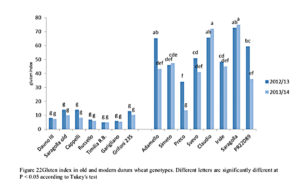
The first glance goes to the ancient grains (the site clarifies the ancient term or, better, neither from a generally shared interpretation); some ancient grains obviously, since even here there are marked differences. The research focuses on those varieties with a much lighter gluten than (generally) modern grains (figure 22); grains often linked, if not always, to their territory of origin, grains that enhance the territory and also preserve genetic variability. The “modern” grains (briefly those on which Man has laid his hands with specific techniques) are certainly not “ad excludendum” but will be the subject of a later moment.
Cereals (and among these the grains) have a fundamental role in human nutrition and are at the base of the Mediterranean diet because they are the main source of carbohydrates, they provide fiber, B vitamins, mineral salts such as potassium, iron, phosphorus and calcium. The content of vitamins and minerals is greater in the case in which the grain is used in its “In the first decades of the 20th century, the Italian government strongly supported the research so much that in 1925 the project Battaglia del Grano was launched with the aim of making the nation self-sufficient in the production of wheat, without subtracting new land to other crops useful for national economy. The intense programs of genetic improvement carried out after the Second World War, led to the complete substitution of local varieties with new cultivars of reduced size and highly productive with a consequent decrease in the genetic variability of wheat “. (From: Morphological and agronomic characterization of ancient cereal populations Project: Ancient Fruits for new bread – NUTRIGRAN-BIO Project financed with funds from the Rural Development Plan for Umbria 2007-2013). Finally, in the last decades, the progressive industrial transformation concerning the production of bread and derivatives as well as pasta has pushed research towards the creation of varieties with a more tenacious gluten suitable for working with machines. The ancient varieties generally have a gluten not suitable for processing with the machines because they are not very extensible and with reduced stability to the kneading (the kneading time of the ancient varieties can be of few minutes while for the machines it takes much longer times). Modern varieties, not all, meet these needs.
It should be noted immediately, however, what is meant by ancient grains: The ancient term is improper and is used above all in communication, that is quick and concise but, often, misleading. The true differentiation must be made between existing varieties in the past and the object of mass or genealogical selection by man and those obtained by hybridization or genetic modification. These latter varieties are generally the result of different genetic improvement able to respond to different processing methods and different nutritional needs. They will be the subject of studies and research in a subsequent phase. The first varieties include – full-fledged – local or autochthonous varieties. Citing Dr. Ssa Porfiri: “Ancora oggi esistono in Italia varietà locali di Triticum. Solo per citarne qualcuna fra le più conosciute: il farro di Monteleone di Spoleto e il farro della Garfagnana nel dicocco; i frumenti teneri “Solina d’Abruzzo” e “Rosciole” dell’Appennino Centrale; Ruscìe, Saragolla/Saragolle, Marzuolo/Marzuoli nei frumenti duri. E perché al plurale? Perché le varietà locali, similmente alle popolazioni naturali, sono frutto dell’azione combinata di mutazioni, ricombinazioni, fenomeni di migrazione e deriva genetica, selezione e sono popolazioni bilanciate, in equilibrio con un determinato ambiente, geneticamente dinamiche, ma anche soggette a diversi gradi di selezione attuata dagli agricoltori. Pertanto, grazie alla loro variabilità all’adattamento a assumono tratti differenziati, tali da consentire una diversa identità genetica in ogni ambiente.”
Deepening:
1) Concept of species, variety
2) Morphological and agronomic characterization of ancient cereal populations